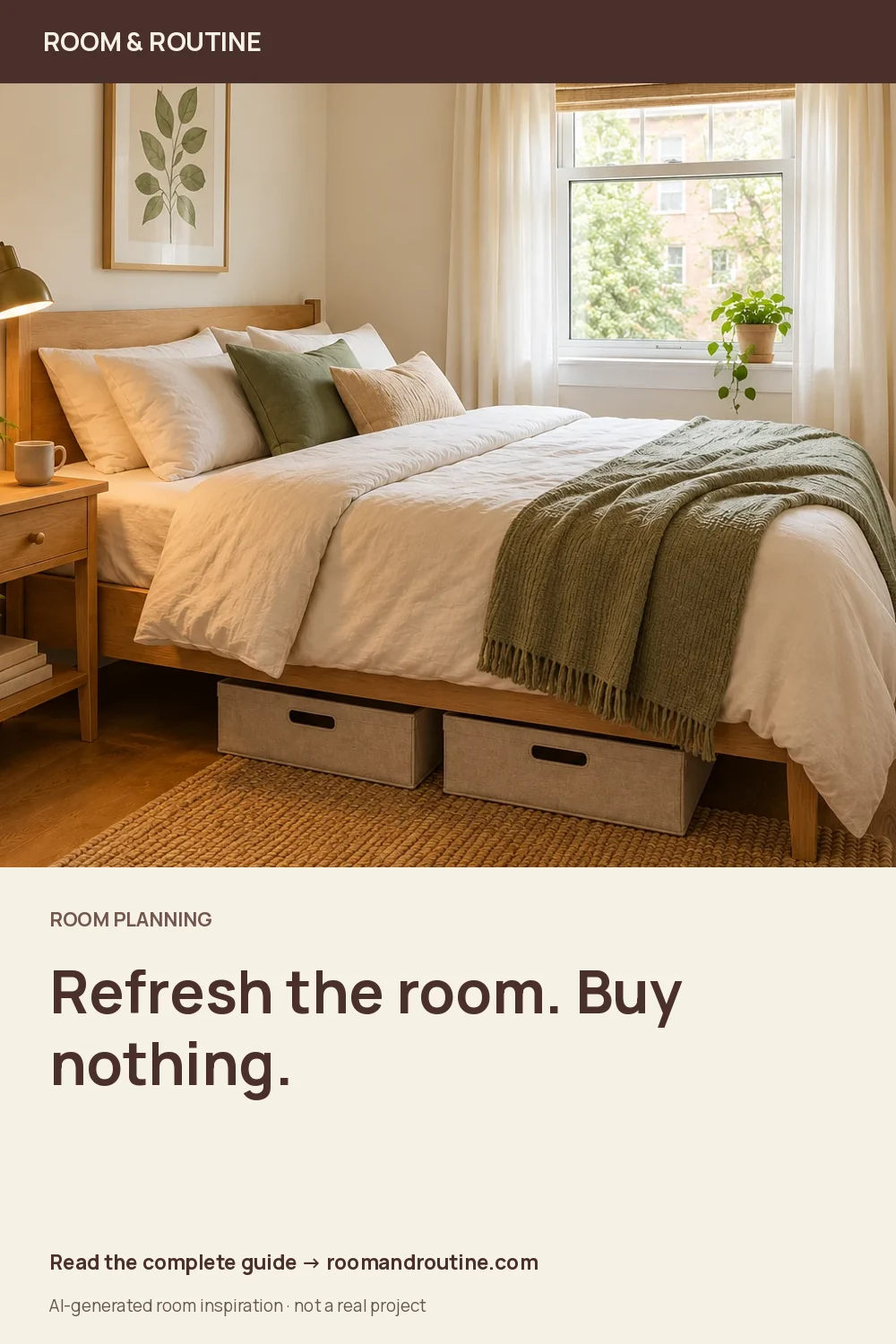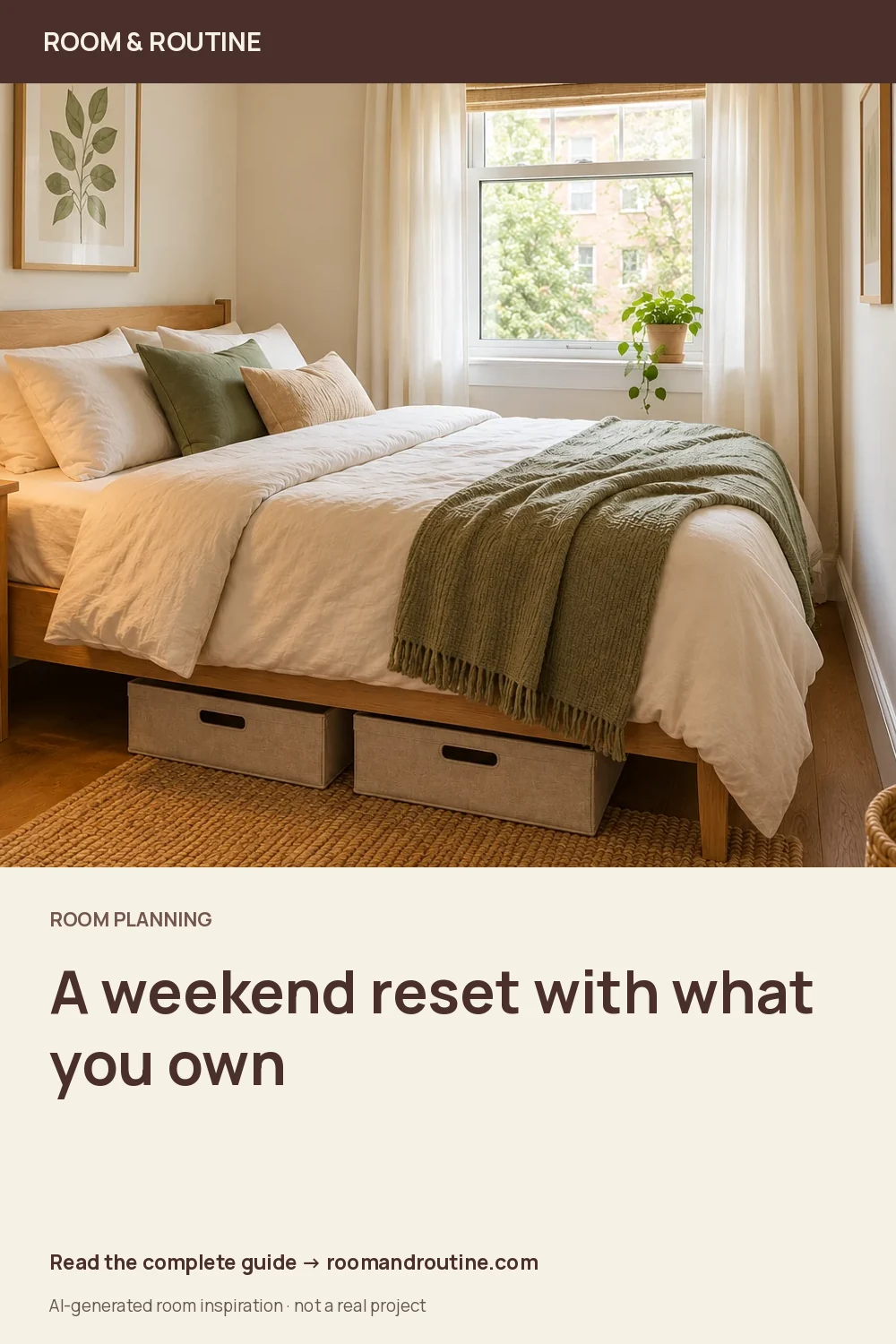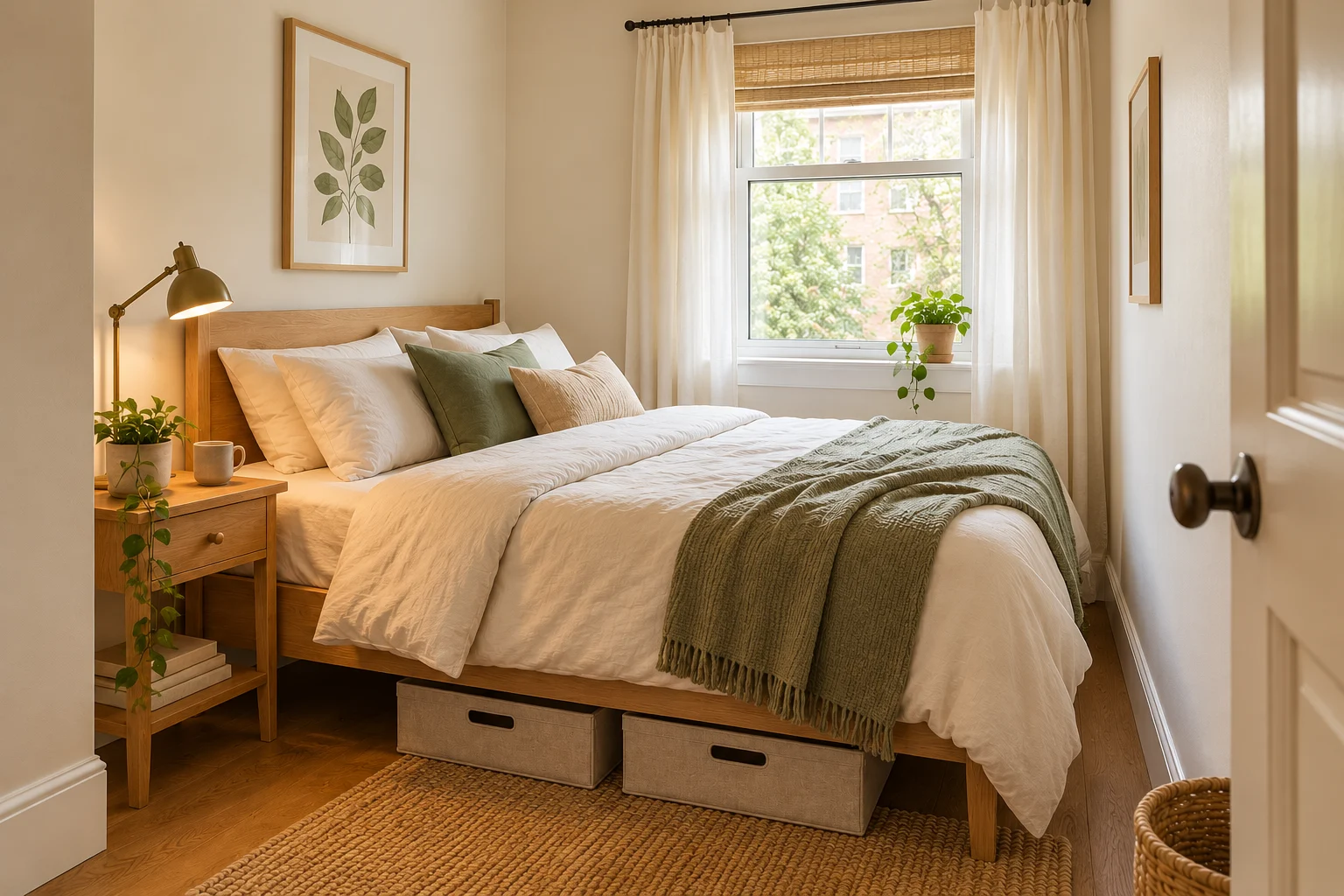
Friday: choose one ordinary problem
Pick a room and name what you want it to do better. A bedroom might need a clear bedside surface; a living room might need a comfortable reading seat; a study corner might need an easier place for papers. Keep the goal specific enough that you can tell whether it improved. 'Make everything beautiful' is difficult to test. 'Read without moving the lamp and a stack of books' gives you a clear starting point.
Set a no-buy boundary for the experiment. Look around the rest of the home for pieces that are genuinely available to move, but avoid disrupting another working space. Gather measurements, a cloth suitable for the surfaces and a place to put temporary categories. There is no need to finish the entire room over a weekend. One useful improvement can show what the room actually needs next.
Saturday morning: clear one working surface
Choose the surface most closely connected to the problem. Sort its objects into things used here, things belonging elsewhere and things requiring a decision. Do not simply move the whole pile into a cupboard. Return the first group deliberately and give the second group its real home. Keep the undecided group small and make time to review it.
Clean only according to the surface's care instructions. Look at the cleared area before adding decoration. Notice whether a regularly used object is now easier to reach or whether the missing pile reveals a storage need. This is useful information. Leave enough free space for the activity that happens here rather than rebuilding a display that has to be moved every day.
Saturday afternoon: move one manageable piece
Try a lighter item first: a side table, a lamp or a chair you can move safely with appropriate help. Measure the new position and check nearby doors, drawers and cables. If the change involves a heavy, tall or fixed piece, plan the movement and any required installation properly instead of treating it as a quick styling exercise. Follow the manufacturer's instructions and keep routes clear.
Test the arrangement while doing the activity you chose on Friday. Sit down, reach for the book, open the drawer and walk through the room. In the 3D Room editor, enter real dimensions and save the alternative as a separate copy before moving the actual furniture. Its model references can clarify the idea, but they do not replace a check of the physical room.
Saturday evening: test the light you already have
Look at the room at the time you normally use it. If an existing movable lamp can serve the task better from another suitable position, try it there. Check glare from the seat and whether the switch is convenient. The change may make the corner feel more comfortable without requiring a new fixture. Do not modify electrical parts or use a product outside its instructions.
Notice how the rearrangement affects the wider room too. A reading corner should not leave another regularly used route difficult to see. If the available lighting cannot support the activity suitably, record that need for a later decision rather than claiming the no-buy refresh solved it. This weekend is a way to understand the room as well as improve it.
Sunday morning: reuse a texture or familiar object
Try a textile you already own where it has a practical use. A throw can be moved to the seat where it is needed; bedding can be simplified; a washable cover can make a piece easier to maintain. Check size and care information before repurposing an item. Start with one change so that you can see whether it helps the colour story or merely adds another thing to tidy.
Choose a personal object worth giving space to: a photograph, a book or something handmade. Place it where it can be seen without taking over the working surface. If several objects compete, keep the most meaningful one out and store the others appropriately for another time. Personal does not have to mean every possession is permanently on display.
Sunday evening: record what is worth keeping
Write three short notes: what became easier, what did not work and what is still unresolved. Keep a photo for your own comparison, with the same general viewpoint if possible. A record of a real experiment is more helpful than deciding only whether the room resembles an inspiration picture. Give the arrangement a normal week before making another round of changes.
Save the room plan, palette or layout in My Home if you used our tools, and download a backup if you want to move those records to another browser. The 3D editor has its own project backup, including any photo or imported models. A no-buy refresh succeeds when the room serves an ordinary routine better. It can also prevent an unnecessary purchase by showing that the existing piece was useful in a different place.
Try a measured furniture arrangement in the 3D Room atelier ↗
Keep the useful part.
Save the full guide to Pinterest or download a vertical graphic. Room imagery is illustrative and AI-generated, not a photographed result.