A guest can admire a beautifully made bed and still have nowhere to put a bag. The useful question is what happens in the first ten minutes: where the case opens, where tomorrow's outfit goes, and whether shoes end up in the doorway. Make those actions easy and the room becomes comfortable without a hospitality-sized budget.
This guide plans for ordinary short stays, with two original arrangements: a dedicated double bedroom and a room that also serves as an office. Neither requires buying a matching furniture set. Start with what guests can actually use, then add decoration to the space that remains.
Measure the unpacking action, not only the furniture
Open the largest suitcase likely to be used. Measure its base and the full open footprint, including the lid. Check how the hinges behave: a hard-shell case may spread across a much bigger area than a soft bag. A surface that holds a closed case can fail the moment it opens.
Mark the support surface on the floor with removable tape, then stand where someone would unpack. Allow the lid to rest securely without pressing into a window, lamp or sharp furniture edge. Try bending to the bottom of the case. If the surface is very low, a guest may prefer unpacking into a drawer immediately; if it is high, lifting a heavy bag can be difficult.
Measure the bed frame, not only the mattress, and open the entry door fully. A useful trial is an approximately 90 cm walking strip along the main route, with more space where a particular guest needs it. That is an editorial planning starting point, not an accessibility or building-code specification. Test the route with the actual person, luggage and mobility equipment where relevant.
Record sockets, radiator positions, window handles and any cupboard doors on your sketch. The suitcase spot belongs outside these working areas. Include the route to the bathroom, because that route matters after dark as well as during arrival.
Give the suitcase its own unpacking position
Why this arrangement is useful
A separate luggage surface and empty clothes zone let the guest unpack without using the bed.
Try the idea in your room
- Measure an open suitcase and test it on an appropriately rated, stable bench.
- Reserve empty shelf space and a few hangers outside window and door working areas.
- Walk from the door to the bed while the suitcase remains open.
Choose one unpacking method the room can support
| Room situation | Useful choice | Check before committing |
|---|---|---|
| Dedicated bedroom with a free side wall | Stable bench or luggage stand | The open case fits and the bench does not narrow the bed route |
| Office used for occasional overnight stays | Foldable luggage stand plus cleared drawer | The stand stores without occupying the guest drawer |
| Very small room | Unpack into one empty drawer and a short rail | The case can close and leave the floor route clear |
| Guest who avoids lifting heavy bags | Accessible floor-level unpacking area agreed in advance | Storage and circulation suit that guest's movements |
Arrangement one: bed, suitcase bench and a small clothes zone
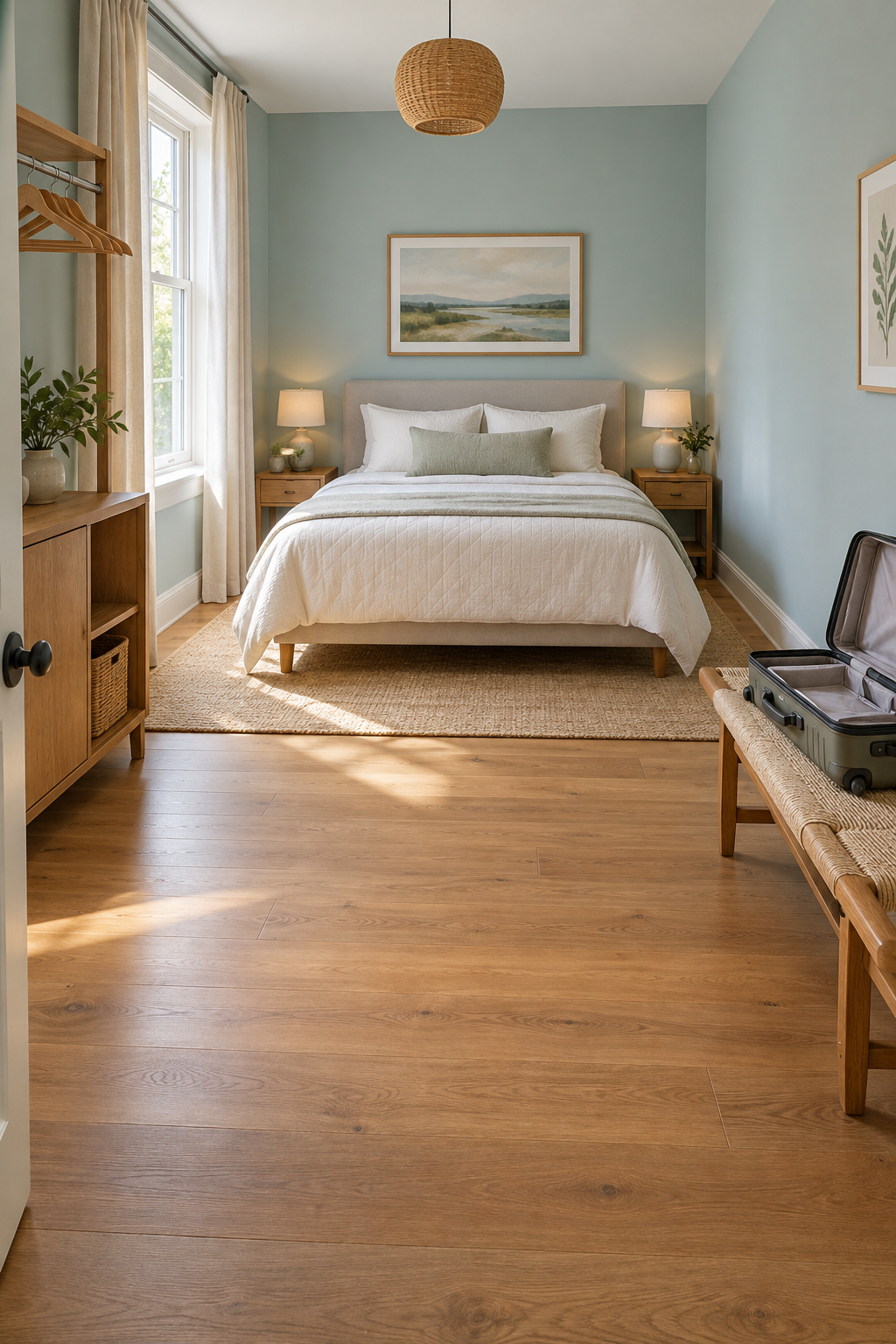
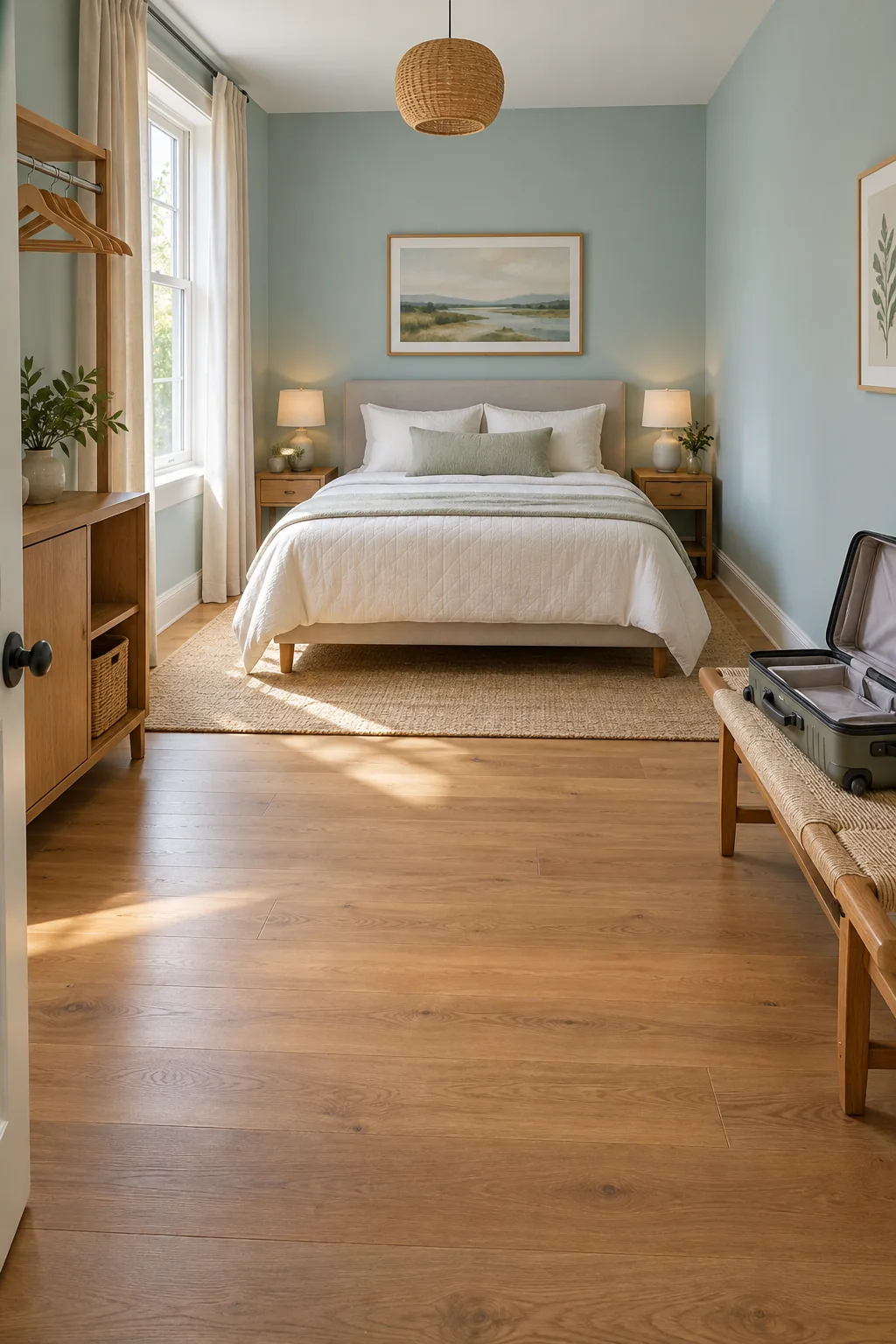
In the first concept, the double bed occupies the rear wall, the unpacking bench sits on the right and a short clothes zone sits on the left. The arrangement keeps the case out of the sleeping surface, so bedding does not become the only place to sort clothes. The empty shelf and hangers make it possible to empty the case and close it for the rest of the stay.
Recreate the sequence with a bench rated for its intended load, a few spare hangers and a drawer that is completely empty. Leave the bench top free of permanent decor. A guest should not have to relocate a vase or find permission to move your belongings before using it. The image illustrates the arrangement; check the actual furniture's load, stability and fixing instructions before purchase.
A rail does not need to accommodate an entire seasonal wardrobe. Ask whether guests usually bring a jacket, formal outfit or mostly folded clothes. Place hanging and folded storage accordingly. Keep household overflow elsewhere during the visit rather than describing a partly filled cupboard as guest storage.
The tradeoff is floor space. In a tight bedroom, a long bench can take away more usable circulation than it provides. Test a short stand first. If two guests bring separate cases, agree which one stays open or provide two independent landing positions instead of balancing bags on each other.
Arrangement two: a room that returns to office use
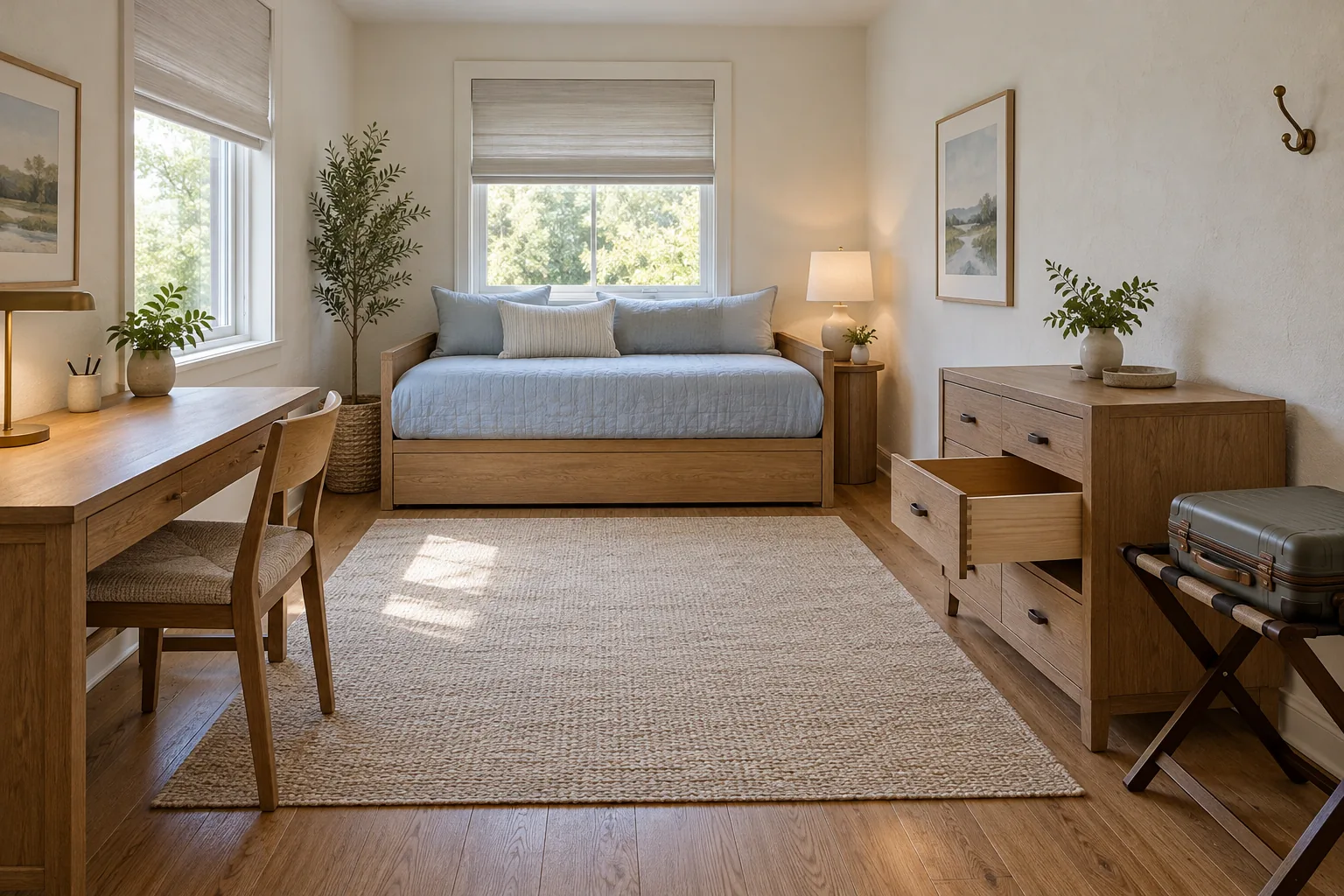
The second concept uses a daybed, desk and a separate unpacking cabinet. The desk chair tucks away, while the case has a stand rather than spreading across the work surface. That separation helps when the office contains equipment or paperwork you cannot simply remove.
Put work items into closed, private storage before arrival. Clear a real drawer for the guest and move the stand into place only when needed. If a daybed pulls out, trial the full sleeping configuration before deciding where the stand belongs. A layout that works with the bed closed may leave no route when it extends.
Keep the bed conversion manageable for the host. Store bedding where it can be reached without moving a heavy cabinet, and practise the conversion once with the floor arranged for a visitor. An occasional room should not rely on a complicated sequence of furniture moves each night.
Make the bedside area understandable
Give the guest a surface for a phone, glasses and a glass of water. It can be a small existing stool or a secure wall-mounted shelf where permitted. Put the lamp switch within reach from the bed and make the night route visible. Avoid a trailing extension lead across the route; choose a different lamp position or have electrical changes handled appropriately.
Keep daily information simple. Show the guest how to operate the blind, where extra bedding lives and which storage is theirs. If window coverings have accessible cords and children may visit, review the CPSC's cordless guidance. A spare room does not make a cord hazard irrelevant.
For a narrow bedside gap, the separate bedside-table alternatives guide can help choose a surface without enlarging the room's furniture footprint. Match the solution to what the guest needs to reach, rather than copying the image's accessory arrangement.
Budget and renter choices
The lowest-cost improvement is often clearing existing storage. Reserve one drawer, remove spare possessions from a shelf and reuse a stable stool as a bedside surface. Check that an existing bench is suitable for luggage; a decorative seat with a delicate woven top may not tolerate the concentrated weight of a heavy case.
A foldable luggage stand helps renters because it does not require a permanent fitted cabinet. A freestanding hanging rail can also work if it fits the room and is used within its load limits. Keep rails away from the door swing and do not hang so much clothing that the frame becomes unstable.
For dressers or other storage furniture, follow the manufacturer's anchoring instructions. CPSC's Anchor It! campaign addresses furniture tip-over prevention. Where a tenancy limits drilling, discuss permitted fixing with the landlord or choose a different appropriate storage solution; an adhesive hook is not a substitute for a specified anti-tip fixing.
A reset that keeps the room ready for the next visit
- Empty the guest drawer and check behind it for belongings.
- Check the unpacking surface for loose joints and clean it for the next case.
- Wash and fully dry the bedding, then keep a complete set together.
- Return the stand to its storage position without blocking office equipment or household storage.
- Walk the bed-to-door route again after resetting the room.
Before a longer visit, check storage capacity with the guest rather than adding piles of baskets. A suitcase surface is an arrival tool; the drawer and rail are the storage system for the stay. If the case needs to remain open all week, the room may need more empty clothing space instead of another decorative surface.
Common mistakes to avoid
Offering storage that is not empty. A cleared drawer should not contain items the visitor must handle. Using the bed as the only luggage surface. It is inconvenient once someone wants to rest. Buying a bench before opening a real case. The lid and standing position can change the space requirement considerably.
Making the office conversion depend on moving a loaded bookcase. Reduce movable pieces before improving finishes. Leaving a charging cable across the night route. Test the room in its sleeping setup, with lighting at the level you expect a guest to use.
Planning references
The room arrangements and trial measurements above are original editorial suggestions. Primary references reviewed on 14 October 2026: IKEA's multipurpose guest-room planning, CPSC window-covering guidance and CPSC Anchor It!. Product instructions and the actual guest's needs govern the final setup.
Practical questions
Does a small guest room need a full wardrobe?
Usually the first priority is genuinely empty storage for the expected stay. A drawer and a short hanging section may be sufficient for a weekend, while a longer visit needs more capacity. Ask what the guest brings before sacrificing circulation for a full wardrobe.
Can a desk double as the luggage surface?
Yes, if the open case fits securely and the desk can be completely cleared. Check its load rating and protect the finish appropriately. In a working office, a separate foldable stand may be easier because it keeps equipment and private paperwork out of the unpacking area.
Where should the suitcase go after unpacking?
Choose a reachable, dry location outside the walking route. It may fit beside a cabinet or beneath a bed if there is adequate space and access. Do not hide it where retrieving it requires shifting heavy furniture or covering a heater.
Keep the useful part.
Keep one visual reminder of this guide. The illustration suggests a direction; the practical steps and fit checks above help you adapt it to your own room.