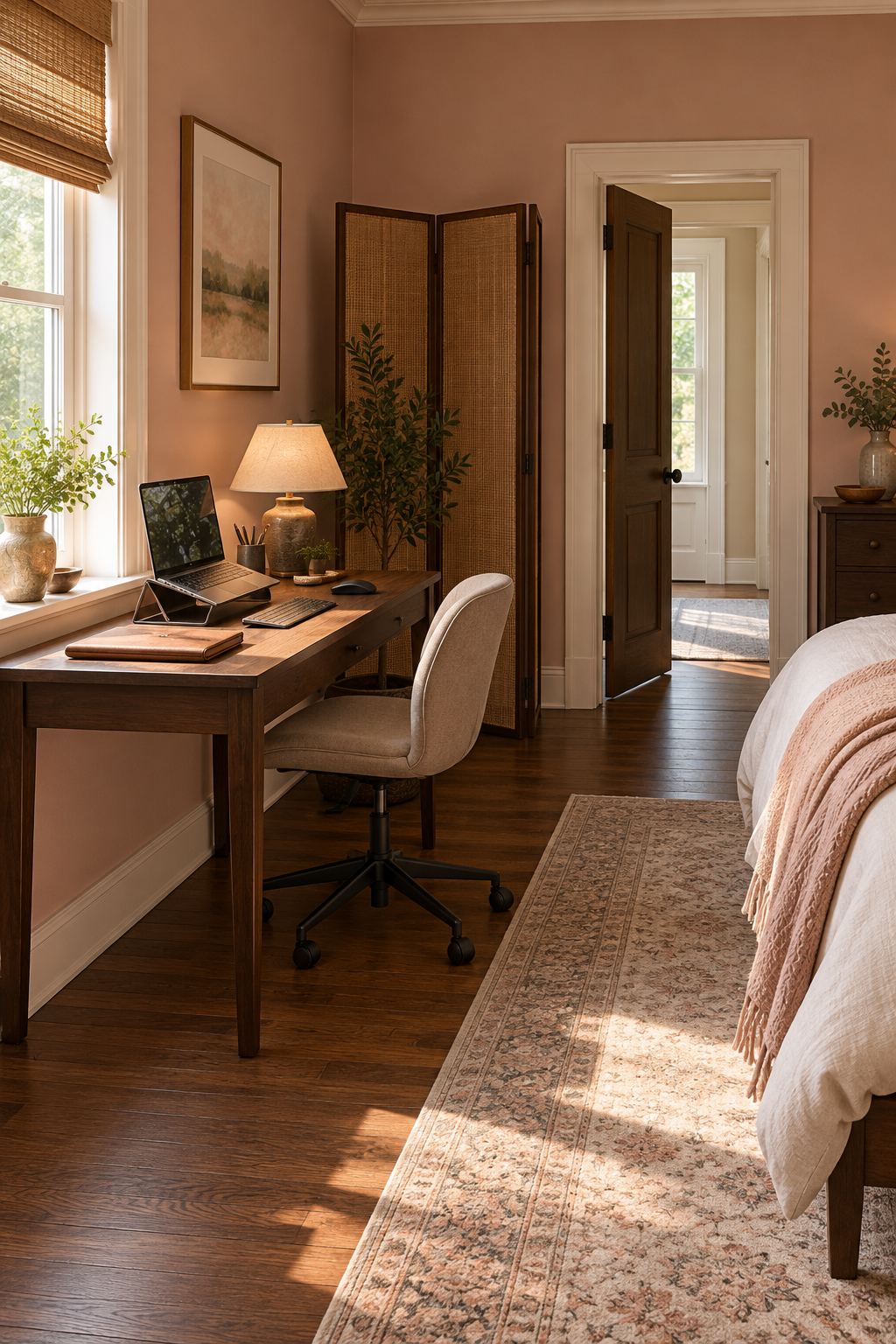
When a bedroom also holds a desk, work can stay visually present after the task has finished. Open folders, charging leads and a glowing screen may occupy the same view you see from bed. The practical improvement is a clear change of use: equipment and papers return to storage, lighting changes and the walking route remains open.
This guide concerns a room arrangement and routine, not a treatment for sleep problems or a guarantee of better sleep. Its two original concepts show an open desk with portable storage and a purpose-built secretary desk after closure. Both start with a usable work position; concealment comes later. Do not choose a tiny folding surface merely because it can disappear from sight.
Map the bedroom during both uses
Measure the bed, wardrobe doors, bedroom door swing and the chair in its working position. Test the route from the entrance to both sides of the bed that your household uses. Include laundry baskets and the space needed to open clothing storage. An empty chair tucked under the top does not represent the room during work.
Then map the evening arrangement. Where will the chair go? Which shelf accepts the laptop or papers? Can someone reach the window and switch off the lamp without stepping around equipment? A desk that fits only while the chair sits on the bed is not a useful plan. Try the change between uses with existing furniture before buying a closing desk.
Open desk with portable work storage
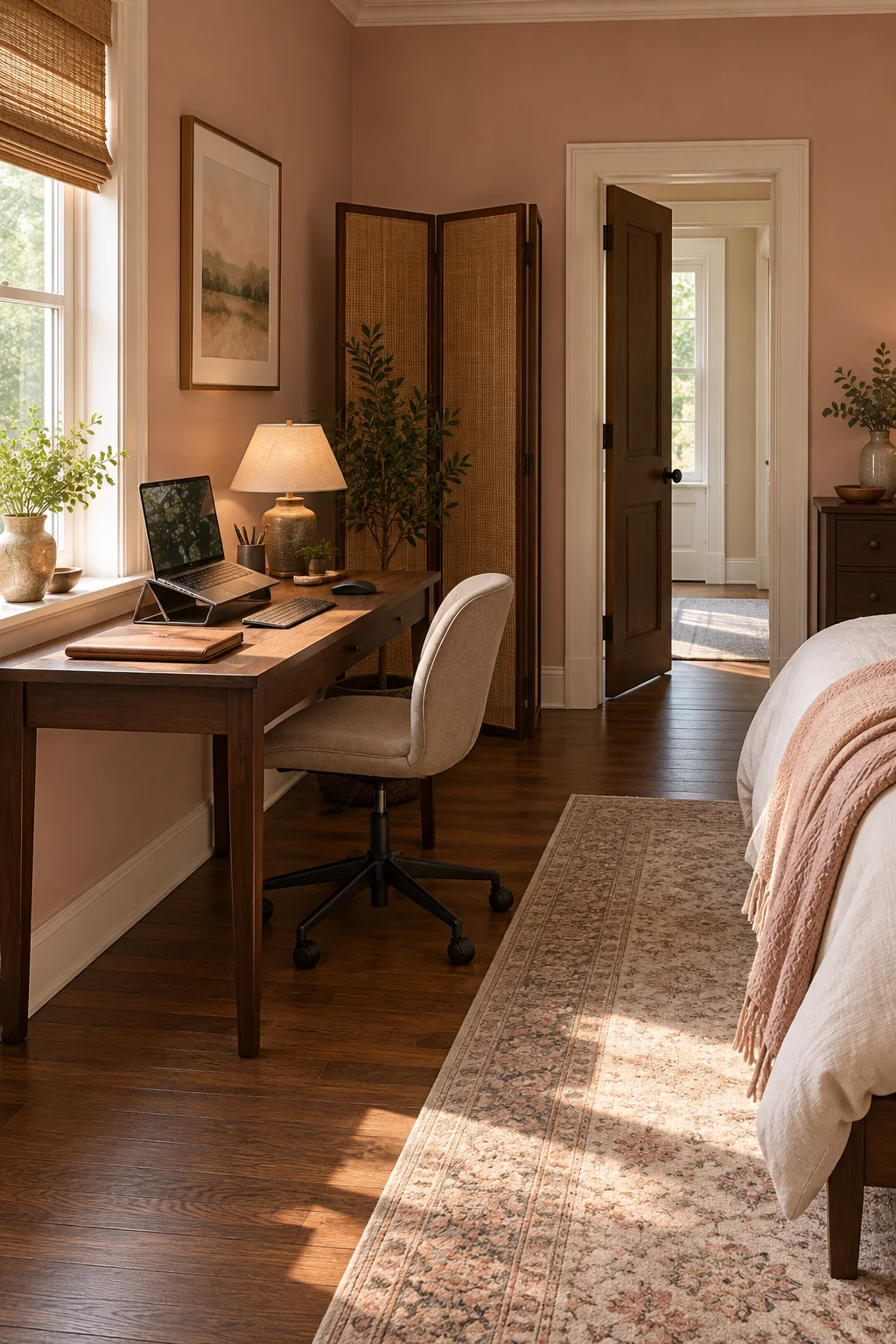
Why this arrangement is useful
The desk fits its user during work and a small kit can leave the surface at the end of the day.
Try the idea in your room
- Test the working chair with bed and doors in use.
- Give papers one portable pouch or tray.
- Keep any screen clear of the route and controls.
Decide what really needs to disappear
Some households only need papers and a laptop put away; others need to hide a full desktop setup. List the visible items that make the room feel like work. A portable folder may solve the largest issue. A large monitor can be harder to hide, so consider whether its permanent position can face away from the bed or sit in a suitable separate enclosure.
Do not conceal equipment behind tightly packed textiles or place a cover over devices that need ventilation. Follow the maker's operating, charging and storage instructions. Shutting a drawer is not a substitute for checking whether a charger or running device can safely operate inside it. Give any equipment that needs continuous operation an appropriate location instead.
Where a separate room is available, using the bedroom only for rest may be the clearer boundary. Cambridge University Hospitals sleep guidance advises avoiding stimulating activities such as work in the bedroom. In a multi-use home, the reset below is a practical compromise, not a medical treatment or a promise of better sleep.
Compare the possible boundaries
| Approach | What it can achieve | What must be checked |
|---|---|---|
| Plain desk plus work pouch | Clears active papers and small tools | Whether larger equipment can remain calm in the room |
| Purpose-built closing desk | Hides a compatible work kit behind a panel | Surface support, loading, hinges and storage dimensions |
| Freestanding screen | Changes the view from the bed | Stability and whether it blocks circulation or light |
| Desk facing away from bed | Reduces the direct view of work equipment | Daylight, glare and the chair's occupied footprint |
No boundary should require moving the bed every evening. Choose the simplest action that clears the visible work. For a rental, use permitted reversible changes and verify the safety instructions for furniture. Do not use a high cabinet as a desk surround while omitting the fixing it requires. A product's solid appearance does not prove that it can stand safely without securing.
Arrangement: a desk beside daylight with portable work
The first concept places a freestanding desk beside a window on a wall perpendicular to the bed. The laptop is raised with separate input devices, and a slim work pouch keeps papers together. A folding screen can change the later view, but it stays outside the route and is not used to support shelves or equipment. The chair has real room to move.
- Mark the occupied chair footprint and confirm the bedroom door, wardrobe and bed route still work.
- Assign a folder or tray to all active papers, sized so they can move without rearranging each sheet.
- Choose a safe storage or screen position for the evening that leaves controls, airflow and circulation available.
The desk should fit its user rather than match the height of a bedside cabinet. Use it for a realistic session and adjust the chair and equipment together. The nearby window is helpful only if light reaches the page without creating strong screen reflections. Change the screen angle or suitable window shading if needed, keeping the work position comfortable.
Arrangement: a secretary desk with a complete closure
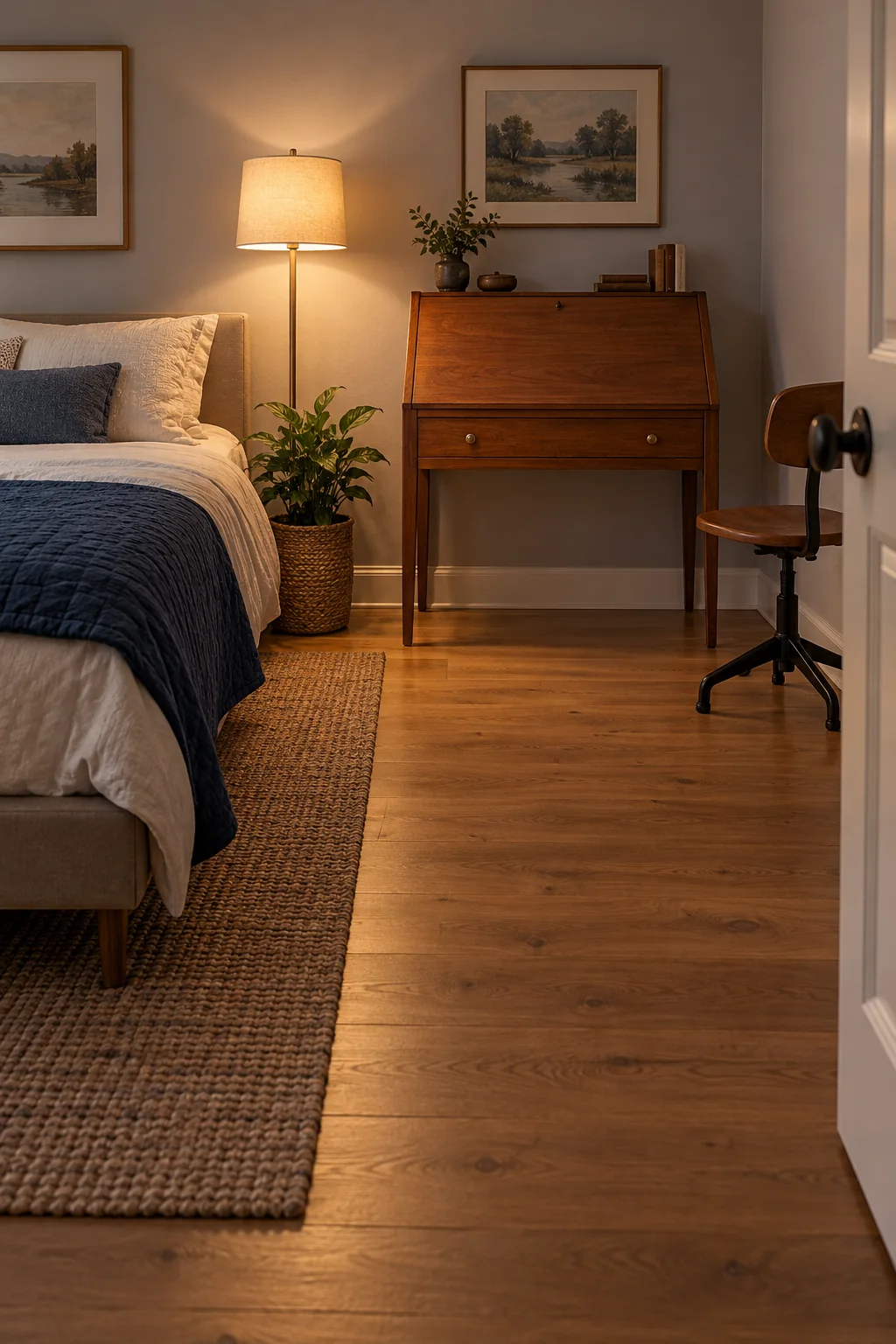
The second concept shows a purpose-built secretary desk after work, with its writing panel closed and the room route open. It uses its intended furniture mechanism rather than a loose hinged shelf attached to the wall. A compatible laptop and small kit can be stored only when their dimensions and the product instructions allow it. Large monitors or bulky reference books may belong elsewhere.
- Measure the desk open and closed, including its supports and the space needed to operate the panel.
- Test the working top with the intended kit within the manufacturer's loading limits.
- Close only after storing equipment appropriately and checking that papers and leads cannot catch in the hinge.
Do not rest body weight on a drop-front top or assume its supports tolerate every task. Check the exact desk documentation and condition, particularly for a used piece. A closing mechanism that sticks, has missing stays or shows damaged joints should be assessed and repaired appropriately before use. The furniture should close without force or improvised wedges.
Keep the working fit independent from the evening look
OSHA's monitor guidance treats screen position as part of the whole workstation, alongside keyboard, chair and desk. We use that as an ergonomic planning reference, not a rule that every bedroom desk must have office equipment. Fit the setup to the person and length of use; a short journaling session and a workday at a screen make different demands.
A separate keyboard and mouse can help arrange a laptop more flexibly when there is room, but buying them does not correct an unstable desk or trapped chair. Keep the most-used equipment within easy reach and leave enough clear top for the intended task. If a small closing desk cannot hold your ordinary work, use a larger suitable desk with a different visual boundary.
Set light for work and for the room afterwards
During work, a shaded task light should illuminate the surface without shining into the screen or across the bed at another occupant. In the evening, put it away or switch it off and use the room's usual lighting. Do not rely on a desk lamp as the only light for the route to the door; its cable and base should stay outside that movement.
When two people share the bedroom, agree on how the work area is used while the other is resting. Headphones, a different location for calls and a closed-folder routine may be more effective than a decorative divider. Do not promise that a small screen blocks sound. If calls and sleep regularly overlap, a different work location may solve the issue more completely.
Create a closing routine with a clear restart
- Save the task and write the next action in one designated place.
- Return papers to their pouch or tray instead of stacking them on the bed.
- Shut down or store equipment according to its maker's instructions and remove any lead that could be trapped.
- Clear the chair and room route, then close the furniture panel or position the screen safely.
- Restore ordinary bedroom lighting and check that clothes, windows and door controls remain easy to reach.
Keep the restart brief too. A kit that takes a long time to unpack may tempt you to leave the desk open all night. Use one active folder and one small tool container. Archive finished work outside the bedroom if it no longer needs to be part of the daily setup. Avoid buying extra closed storage until you know which objects really need it.
Review the boundary after several evenings
Notice what remains in view and why. If a keyboard will not fit, the storage gap is wrong. If the chair blocks the route, the desk orientation needs revision. If the screen is always folded away, it may be unnecessary. Spend on the specific missing part rather than replacing the whole room.
For regular employed home working, use the assessment appropriate to your role and location. HSE's applicable UK guidance calls for individual DSE assessment where its regulations apply. The bedroom's attractive closed state cannot replace that working review. The final plan should make both activities possible without one depending on a permanent compromise in the other.
Planning references reviewed on 21 October 2026
- OSHA: Computer workstation monitors: Screen placement considered with keyboard, chair and lighting.
- HSE: Using computers and laptops safely at home: Individual workstation assessment in applicable UK work settings; personal furniture still needs to fit the user.
- Electrical Safety First: Extension leads and adaptors: Avoiding overloaded or chained extension leads; UK electrical context, local products and rules may differ.
- Cambridge University Hospitals: achieving better sleep: avoiding stimulating bedroom activities; included as general patient guidance, not a claim that this layout treats sleep problems.
Practical questions
Will hiding the desk improve my sleep?
This guide does not make a medical or sleep guarantee. Hiding work can change the room's visible use and create a practical end-of-day boundary. If sleep problems persist, address them through suitable personal or professional support rather than relying on furniture.
Can I charge my laptop in a closed secretary desk?
Only follow arrangements permitted by the laptop, charger and furniture instructions, with required ventilation and clearance. Do not assume a closed storage space is suitable for charging. Avoid trapping leads in panels or covering operating equipment.
Do I need a folding screen?
No. A paper pouch, a closed laptop and a desk facing away from the bed may be enough. A screen is useful only if it changes the view while remaining stable and outside the routes, daylight and controls your bedroom needs.
Keep the useful part.
Keep one visual reminder of this guide. The illustration suggests a direction; the practical steps and fit checks above help you adapt it to your own room.