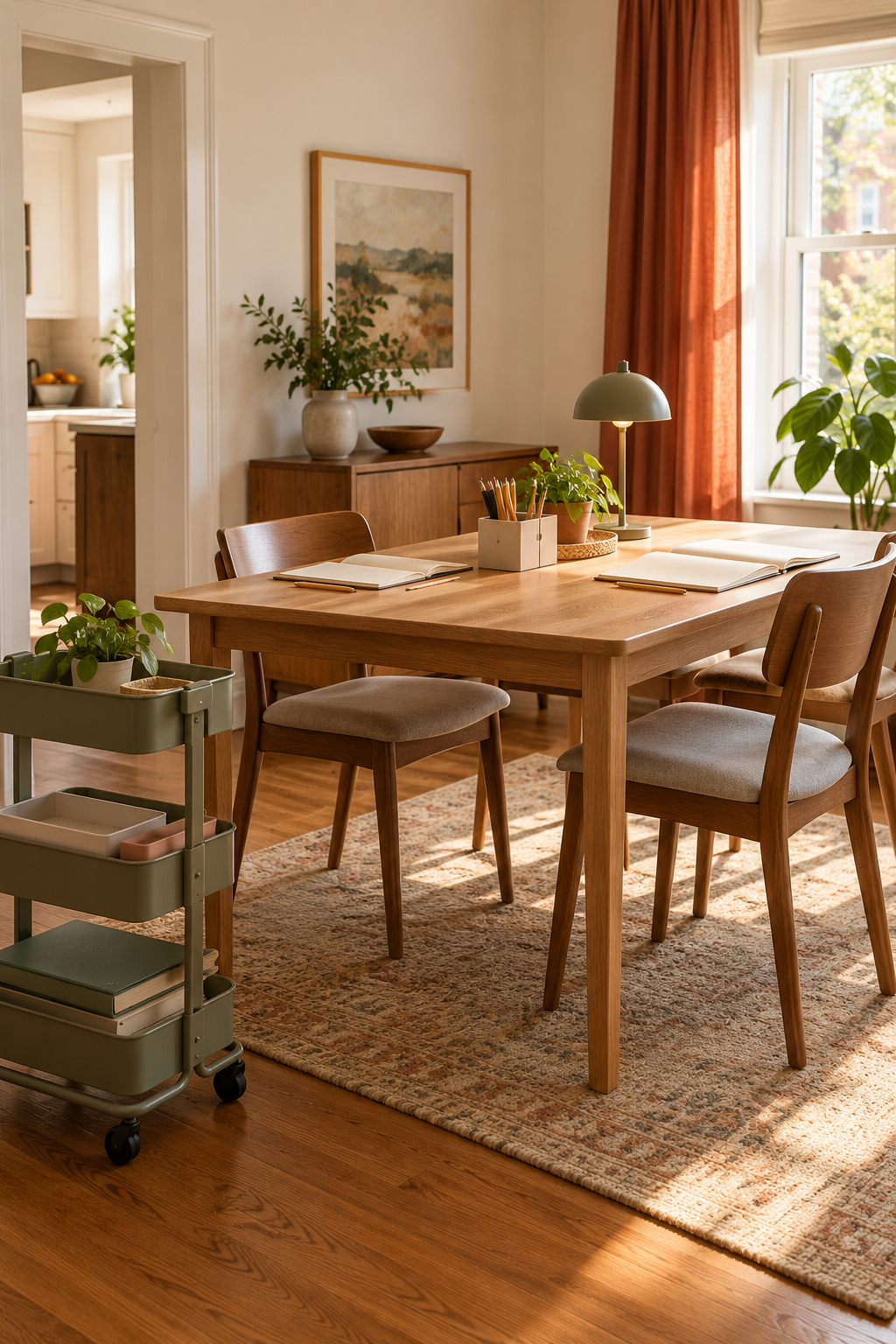
A family dining table often has to support work, drawing, paperwork and meals within the same afternoon. The difficulty is rarely a lack of attractive organizers. It is unfinished work without a safe place to pause. If everything must be packed into a distant cupboard, papers stay on the table. If a tray has no permanent home, it moves onto a chair and blocks the next use.
Plan the change between activities as carefully as the activity itself. This guide uses two original arrangements: a portable cart for multiple work places and a low console for a quieter meal-first room. The aim is a repeatable reset with ordinary furniture, not a claimed transformation or a guarantee that every child will work in the same way.
Identify what must remain assembled
Sort table activities into quick work and projects that need to pause. A bill, a reading book and a pencil can return to a pouch immediately. A partly built model, a drawing with wet material or several open reference pages need a larger temporary parking space. Decide how these projects pause before buying storage. A shallow tray preserves an arrangement; a closed folder protects loose papers; a lidded box suits small parts after they are safe to store.
Ask each person to bring the equipment they normally use. Make a realistic place setting for the activity, then compare it with the meal place setting. If two spread-out projects cannot coexist on the table, alternate them or use another suitable surface. Do not solve the conflict by pushing one person's work into a small corner where they cannot sit comfortably.
Portable work kits beside the table
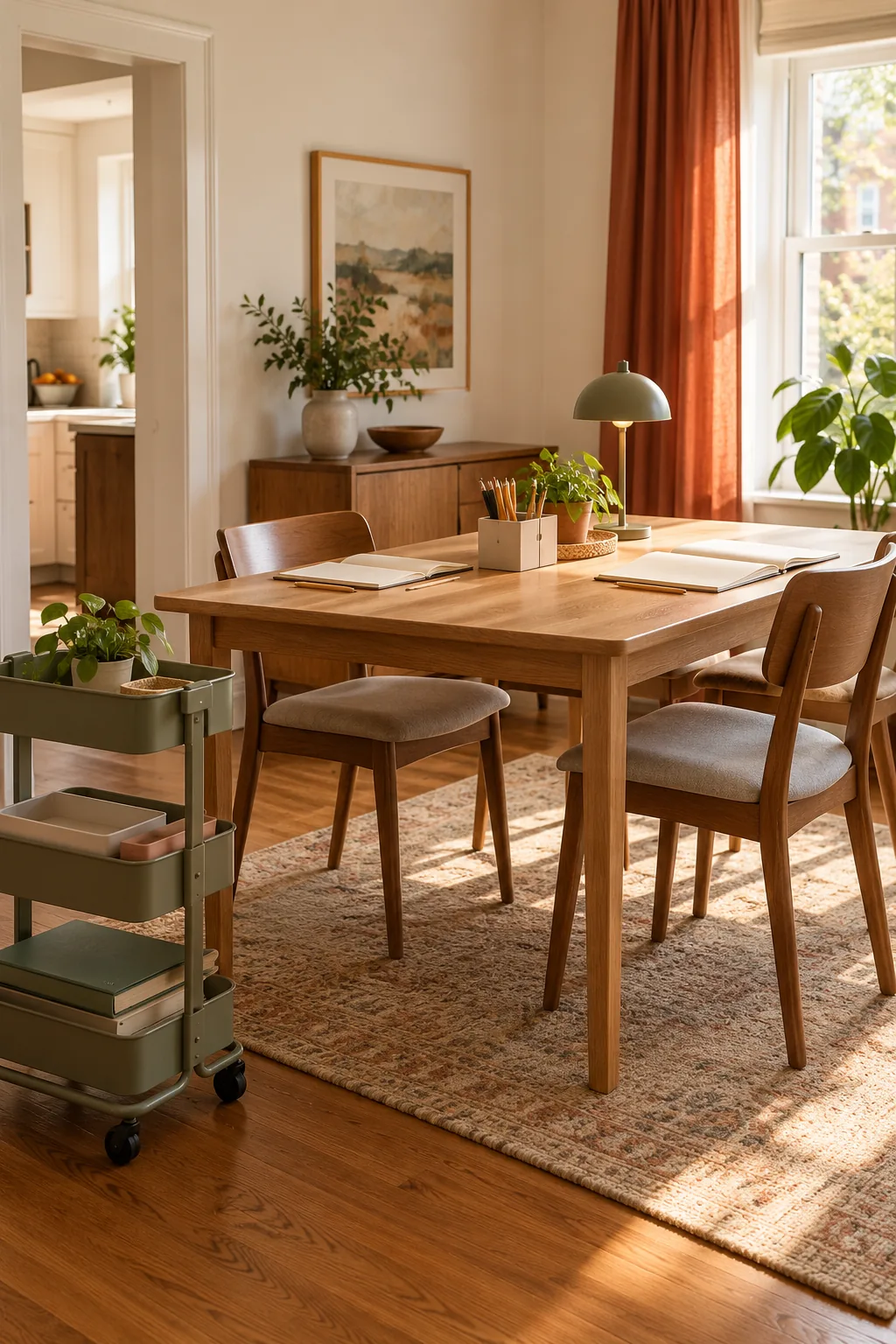
Why this arrangement is useful
Separate kits preserve unfinished work and can leave the meal surface together.
Try the idea in your room
- Give each active project a suitable tray or folder.
- Park the cart away from pulled-back chairs and door movement.
- Test carrying and shelving the filled kit before meals.
Choose a reset destination that can accept the full load
| Storage method | Good for | Main limitation |
|---|---|---|
| Carried tray | A notebook, loose papers and tools that should stay together | Needs a shelf where it can slide in flat |
| Personal pouch | Small everyday supplies and a short study session | Cannot preserve a spread-out project |
| Low cart | Several people with separate activity kits | Needs a parking place outside the chair and door routes |
| Closed cabinet | Visual calm and protected papers | Doors and trays still need working clearance |
Measure the filled tray, not an empty organizer. A pencil cup or open folder can be higher than the shelf gap. Test whether the tray is comfortable for its user to carry without tilting. Young children may need an adult to move it. Keep delicate or heavy work where it can be reached without climbing, and follow the securing instructions for any storage furniture.
Arrangement: a cart beside a shared work table
The first concept has two work places and a small cart beside the table. Supplies live in removable containers, leaving a strip through the middle for shared items. The cart parks beside the room boundary rather than behind an occupied chair. It helps when different people use the table at different times because their kit can move as a unit.
- Create a separate shallow tray or folder for each regular user, sized to the papers they actually handle.
- Find a cart parking position that stays outside the kitchen route and allows trays to be removed without moving diners.
- Return spare supplies to the cart before meals, leaving only the active work on the table until the reset begins.
Do not turn the cart into overflow for unrelated household items. Once shopping bags, toys and cleaning products occupy the tray spaces, homework loses its destination. Keep food and cleaning chemicals separate from work kits. If the cart has wheels, use its locking mechanism where supplied and follow the maker's loading instructions; it is storage, not seating or a climbing aid.
Arrangement: a low console and a meal-first table
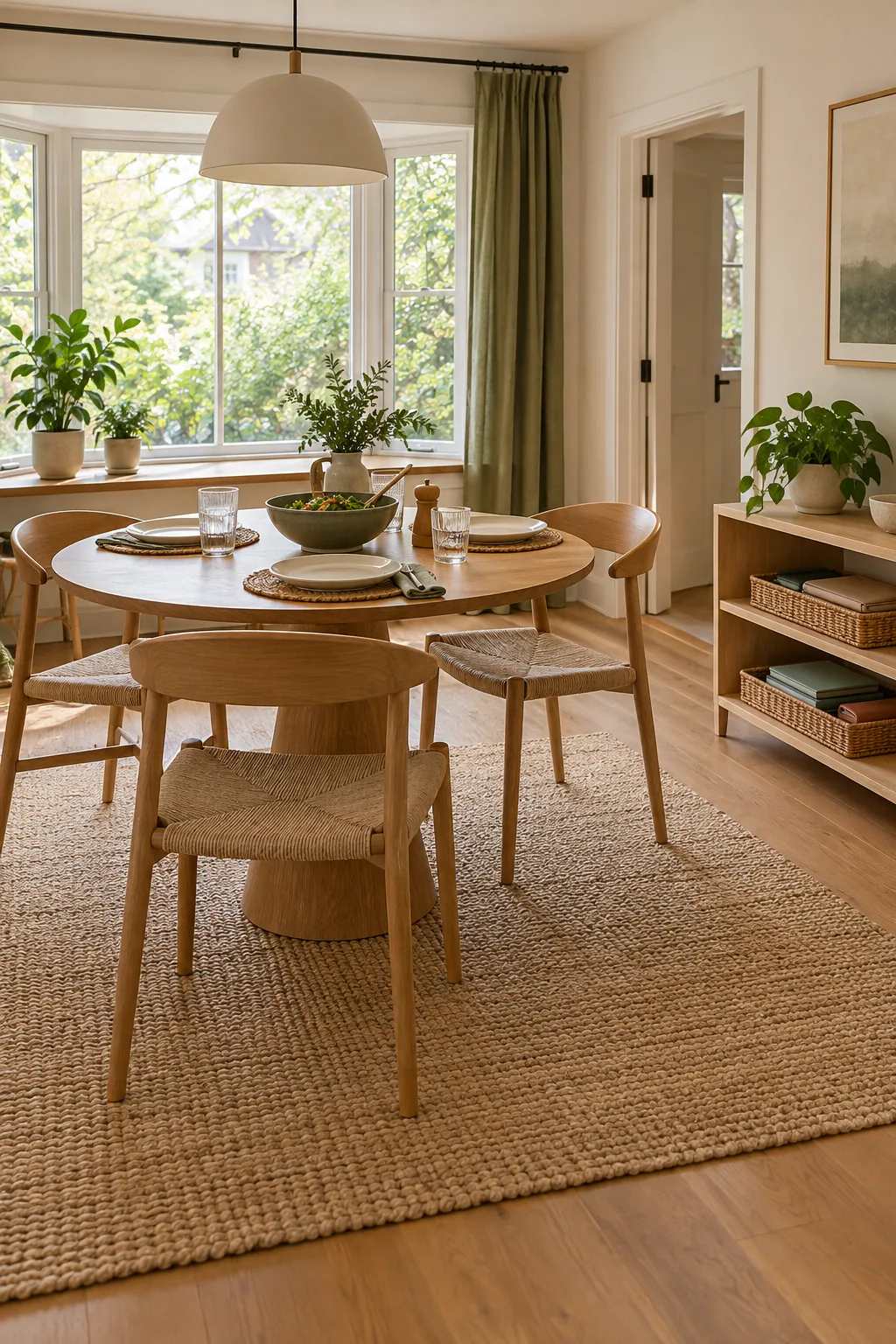
The second concept gives priority to meals. Closed folders and trays return to a low console close to the table, so the top can stay fully usable for plates and a serving bowl. This arrangement suits a household with short writing sessions or a table that doubles as a main social space. It avoids a movable cart in a tight passage, but requires shelves wide enough for the full work kit.
- Clear a reachable shelf for each active tray and leave it free of decorative objects.
- Store the tray with its largest paper flat, or use a folder if the shelf is not deep enough.
- Keep today's unfinished work separate from archived papers so the kit can return to the table without sorting.
Choose open or closed storage according to how the household resets. Open shelves show exactly where the tray belongs; closed doors provide calmer views. Neither works if the shelf is too crowded. The first useful improvement is often removing items from the intended tray space, rather than adding another organizer to the table.
Fit the seat to the user and task
A dining chair can work for a short writing session if the person can sit close enough, reach the surface and support their feet. A soft cushion may lift the user but must not slip or make the seat unstable. For sustained screen work, assess the whole setup, including chair, equipment and working time. HSE's home-working guidance emphasises assessing individual workstations where UK DSE requirements apply. That is not a universal rule that all dining tables are suitable offices.
With a laptop, the screen and keyboard share one body, so improving one position can worsen the other. An appropriate stand plus separate keyboard and mouse may make longer work easier, but only if the table has space. Avoid placing the mouse on a lower side tray while typing on the top. Let each user test the setup and change position rather than copying an adult's chair height for a child.
Give light and drinks separate places
The central dining light may be pleasant for a meal yet cast a shadow over handwriting. Add a suitable shaded task lamp where it illuminates the page without obstructing the user's arms or shining into another person's eyes. Keep its base off the working paper. If the cable crosses a walkway or is trapped by table movement, choose another location or a suitable portable lamp.
Keep drinks on a stable, separate part of the surface, away from laptop edges and loose pages. This is especially helpful when someone reaches across to share supplies. Do not treat a tray as spill-proof unless it is designed for that purpose. Craft adhesives, paints and cleaners should be stored and used according to their labels, with an appropriate surface protector removed before food is served.
Build a reset that has a clear finish
- Pause the activity: save digital work and mark the next step on a separate note or in the project folder.
- Return tools and loose pieces to their assigned container. Store work that is safe to move in its tray.
- Move the complete kit to its designated shelf, leaving the chairs and table edge clear.
- Clean the table using a method suitable for its finish and the activity just completed; allow it to dry.
- Set the meal places and keep food preparation separate from unfinished craft materials.
Keep a small empty space for tomorrow's work rather than leaving every folder open. The final check is practical: all meal seats can be entered, serving dishes fit and someone can walk to the kitchen. If one project remains too large to park, give it a dedicated temporary surface away from food and circulation.
Spend on the missing part, not the whole room
Try existing baking trays used only for nonfood projects, clean document folders or suitable baskets before buying a full storage system. A tray should be stable, smooth and large enough for the work; avoid using damaged containers or sharp-edged packaging. The lowest-cost change may be moving a shelf's contents so a project finally has a place to pause.
After a week of use, note where the reset stalls. If papers are left behind, the folder may be too small. If trays are heavy, divide the kit. If chairs become storage, the parking shelf is inaccessible. Change that one failure before adding another cart. IKEA's multifunctional dining guidance also uses portable activity storage and varied lighting; the household routines here are our own planning applications.
Planning references reviewed on 19 October 2026
The furniture trials, reset steps and comparisons above are original editorial applications, not first-hand project claims. Primary references: IKEA: A multifunctional dining room, HSE: Using computers and laptops safely at home. The illustrations are original AI-assisted concepts and do not establish product dimensions or installation suitability.
Continue with the occupied dining-table footprint and the apartment dining-corner guide.
Practical questions
How do we store unfinished homework without losing its place?
Keep the work in a flat tray or a folder with a clear next-step note. Give that complete kit an empty shelf close to the table. Do not mix unfinished work with old papers that must be searched every time.
Does every child need a separate cart?
No. One appropriately sized shared cart can hold separate trays, or a nearby console can replace the cart. The important part is an accessible destination for each active kit and a realistic limit on how many projects stay open.
Can a dining table replace a desk for full-time work?
Sometimes, but it needs an individual fit and workstation review. Surface space alone is insufficient. Check seating, supported feet, screen position, keyboard space, light and interruptions; applicable employment requirements may also need an assessment.
Keep the useful part.
Keep one visual reminder of this guide. The illustration suggests a direction; the practical steps and fit checks above help you adapt it to your own room.