Direct answer: Position powered furniture close to suitable existing outlets, then guide intact cables along visible inspectable furniture or wall routes with compatible accessories. Keep cords clear of rugs, feet, moving mechanisms and walkways; decorative concealment must not replace appropriate electrical installation.
The advice starts with the existing room, product instructions and a practical household routine. The images are original AI-assisted concepts for planning, not photographs of completed projects or technical installation drawings.
Start by moving the furniture, not by adding a longer cord
A cable problem is often a furniture-position problem. The lamp looks right beside a chair, but its nearest suitable socket is on the other side of the room. Before buying a cover or extension lead, check whether the chair or lamp could move a short distance while preserving the seating arrangement. A table lamp near an existing outlet usually needs less management than a floor lamp behind a floating sofa. Make the room plan and the power plan at the same time rather than treating electricity as a finishing detail.
List the powered items in the room and identify what each cable serves. Separate mains-power cords from low-voltage charging and signal cables. Read device instructions and check the actual socket positions. Do not assume every connector belongs in the same organiser or that a multi-outlet product can support any collection of devices. This guide deals with room layout and ordinary compatible organising accessories. Adding, moving or repairing fixed wiring requires an appropriately qualified person and the rules applicable to your location.
Bring the lamp toward the outlet
Why this arrangement is useful
The furniture arrangement removes the need for a crossing cable.
Try the idea in your room
- Identify the lamp instructions and a suitable existing socket.
- Position the table so its normal movement does not strain the cord.
- Use only compatible guides while keeping the cord visible, clear of rugs and undamaged.
Mark a route that can still be inspected
Follow the proposed route with your eye from the device to its outlet. Note furniture feet, reclining mechanisms, doorways, rugs, curtain movement and places where someone regularly places a foot. Keep the route away from those hazards rather than hiding the conflict. CPSC's home electrical safety checklist warns against cords beneath rugs and carpets and presents extension cords as a limited-use solution. A cable hidden under a rug is not a successful room design.
Check the cable's condition and usable length without stretching it. A route needs gentle movement at plugs and connections, not a taut line between the furniture and wall. Keep the socket and plug reachable, and follow device ventilation guidance. If the route only works by crushing a cord behind a cabinet, move the cabinet or change the layout. Do not cut, splice, modify a plug or fit an improvised connection to make the image look clean. Damaged electrical items need the appropriate replacement or repair process.
| Room situation | Layout-first choice | Avoid |
|---|---|---|
| Lamp beside a chair | Side table near a suitable outlet, inspectable wall-side route | Cord crossing the seating aisle |
| Low media console | Open rear access and compatible loose guides | Tight bundles, trapped plugs or blocked device ventilation |
| Floating seating far from power | Reconsider powered accessories or obtain appropriate electrical advice | Using rugs to conceal a crossing cord |
| Reclining furniture | Follow mechanism and cord-clearance instructions | Routing through pinch or moving parts |
Arrangement A: a lamp with a short wall-side route
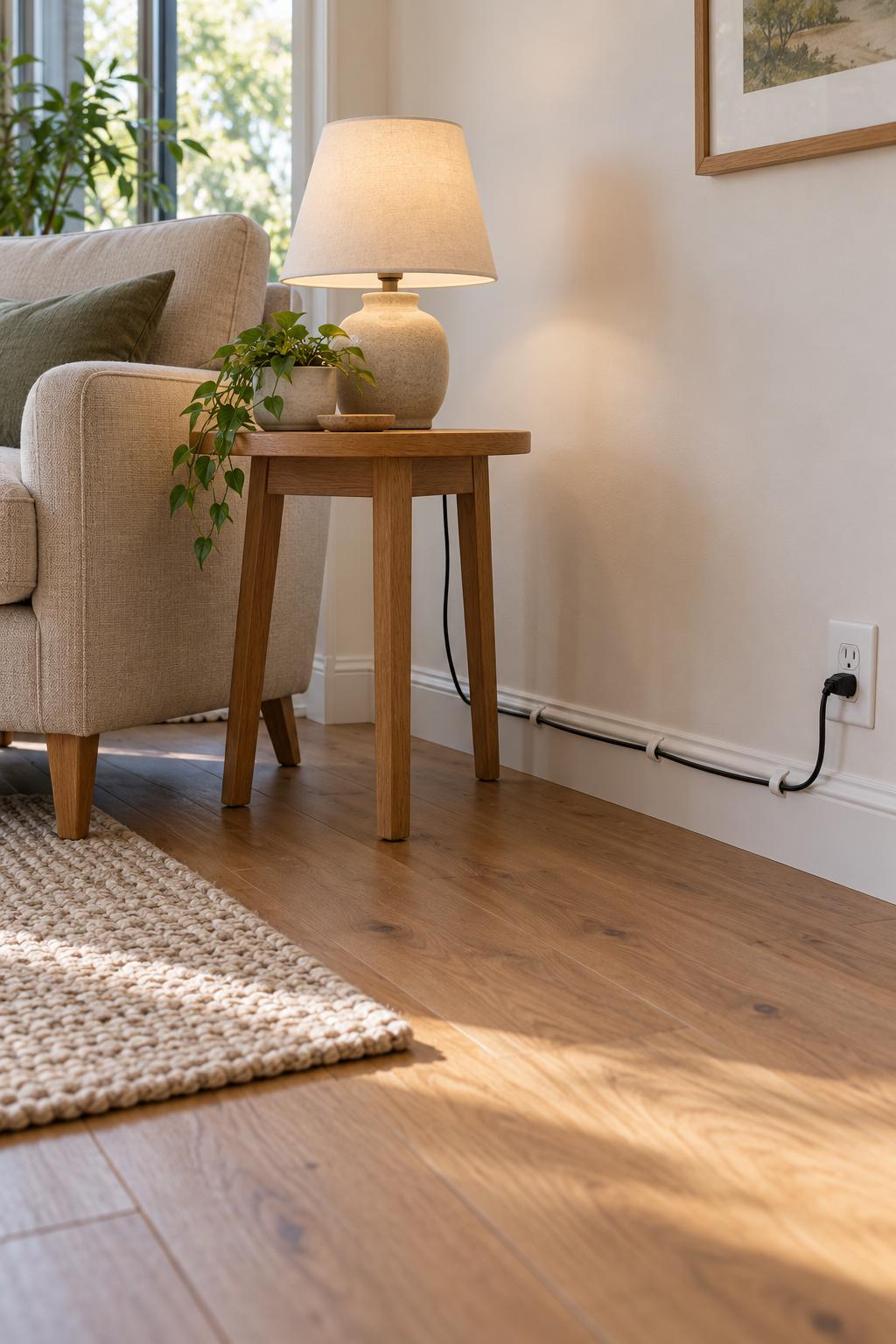
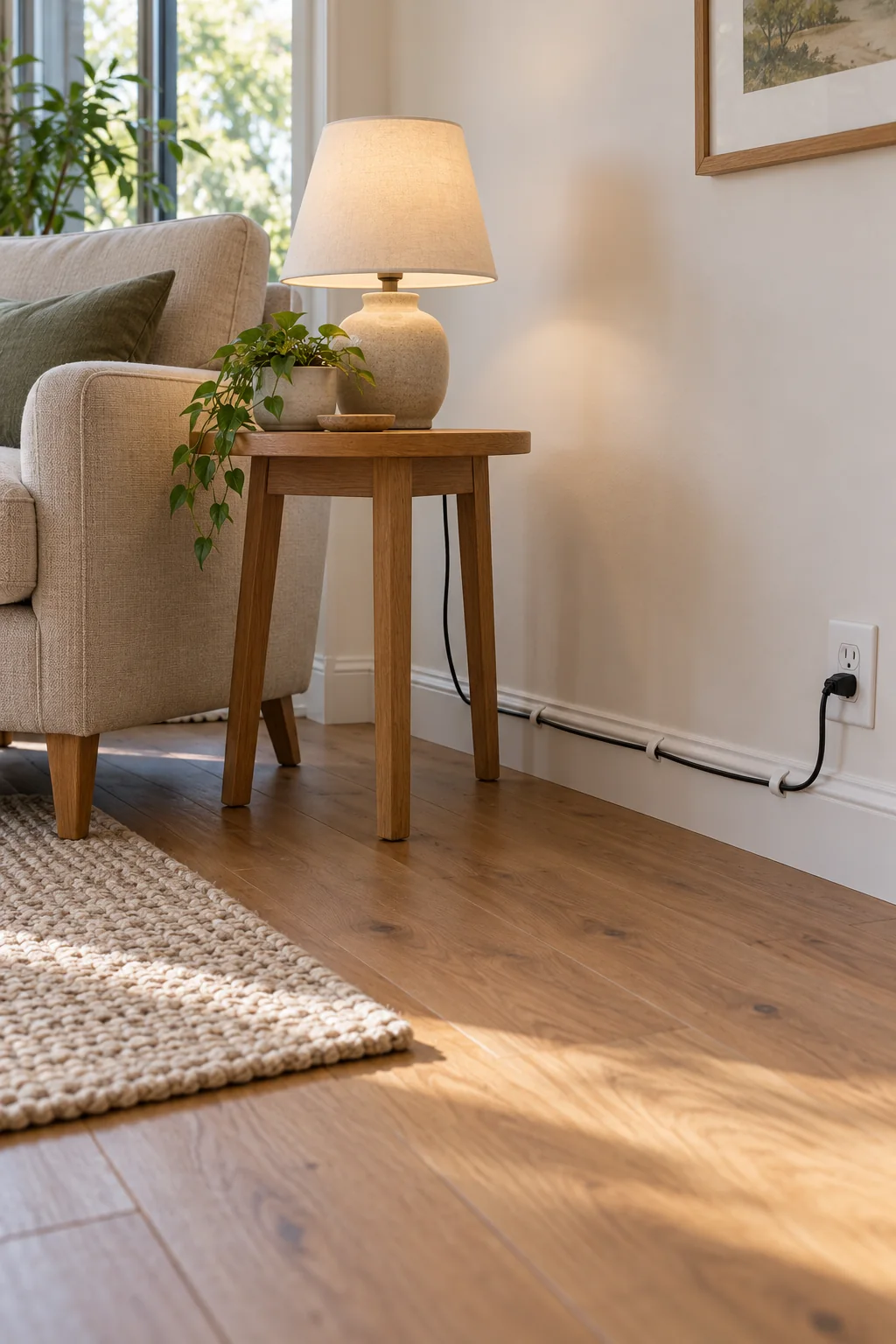
The first concept moves the side table near an existing outlet. The lamp's cord descends at the table's rear, then follows the wall rather than entering the rug or walkway. Compatible open guides keep the route orderly without becoming an airtight enclosure. The important feature is the absence of a conflict: no furniture foot rests on the cord and the plug remains reachable. The image illustrates a concept route, not a certified installation or a product recommendation for any cable type.
Recreate the seating position before attaching clips. Sit in the chair, reach the lamp switch and walk past the table. Then check that the cord remains clear when the chair is moved for cleaning. Choose only accessories suited to the cord, surface and intended use, following their instructions. Do not fasten through a cable or force it into an undersized channel. If the normal movement of the furniture pulls on the plug, reposition the lamp or change the guide points until the device can be used without tension.
Arrangement B: keep the media-console rear accessible
The second concept shows the back and side of a low media console, where a small group of device cables stays reachable. Open shelf space preserves the equipment's specified ventilation and gives room for inspection. Reusable guides separate an orderly route from an over-tight cable bundle. The screen is shown with a restraint; real furniture and televisions should be secured according to their manufacturers' instructions. Cable organisation does not address tip-over risks on its own.
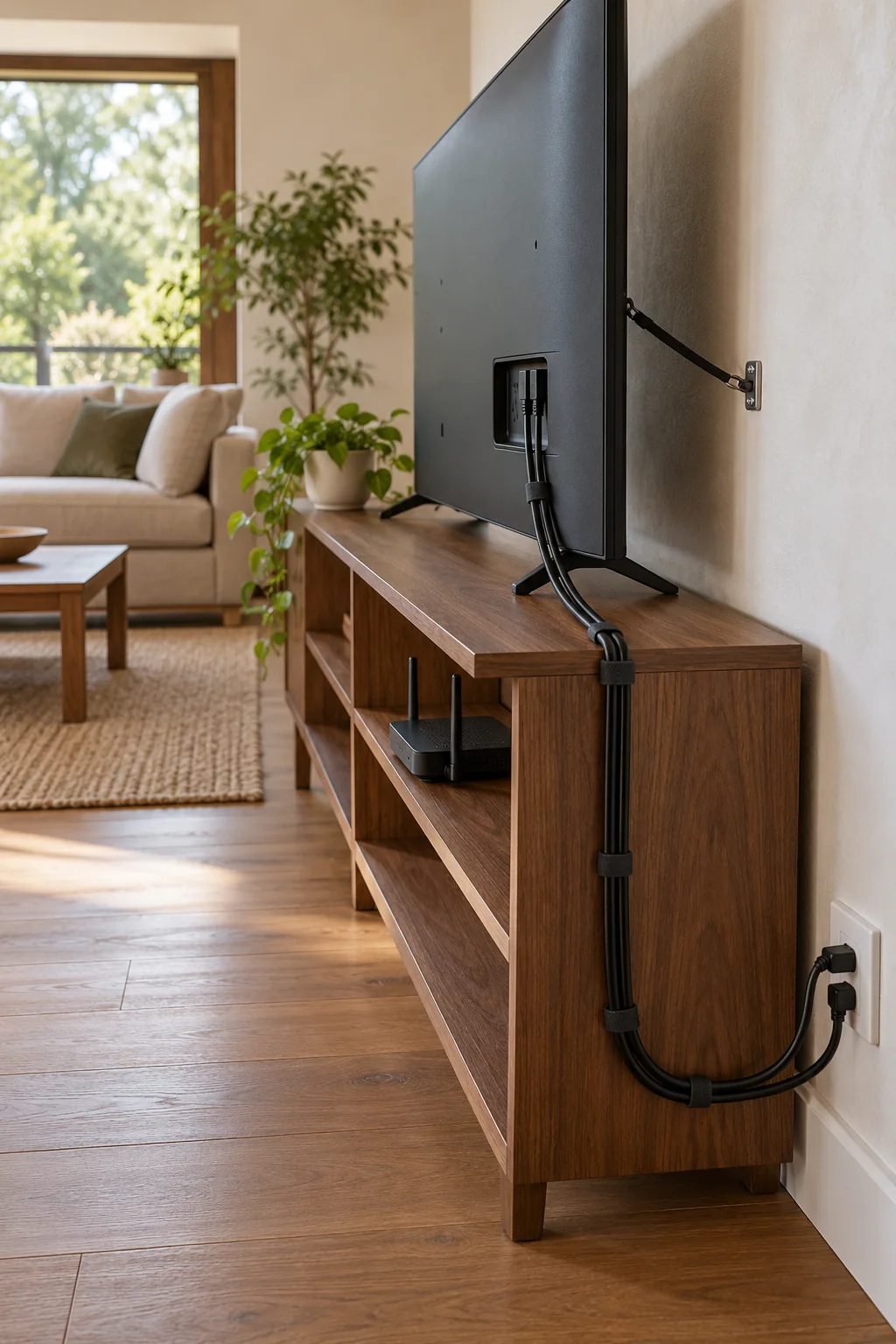
Before consolidating cables, disconnect or move devices only as their instructions permit and keep a note of which cable belongs where. Avoid gathering all excess cable into a tightly compressed knot behind a device. Use the smallest grouping that remains readable and easy to undo. Keep cable guides out of ventilation slots, moving cabinet doors and shelf edges that could damage insulation. If a device needs rear maintenance, leave an appropriate access position rather than forcing the console hard against the wall for a cleaner frontal photograph.
Choose cable-management accessories by function
An open clip can guide a single compatible cable along a route. A reusable strap can keep a small suitable group associated without pinching it. A manufacturer-designed cable entry can guide connections through a console without sharp edges. These accessories solve different tasks; one large concealed box is not a universal substitute. Follow every organiser and device's instructions. If an accessory encloses powered connections or changes heat dissipation, check its intended use rather than assuming the material or price makes it appropriate.
Use a simple identification note for media cables so that a future change does not require pulling everything loose. Ordinary labels in the actual home can help, even though the concept images contain no text. Keep adapters and spare cables in a separate dry container instead of leaving them plugged in unnecessarily. Remove obsolete wires from the active route when they no longer serve a device. Fewer active connections make inspection and room cleaning easier than merely hiding the same tangled mass behind a decorative sleeve.
A careful layout and testing sequence
- Identify devices, existing outlets, cable types and their applicable instructions.
- Check cords and plugs for damage, and resolve any unsuitable item before organising it.
- Move furniture to shorten routes while preserving useful seating and walking access.
- Test inspectable routes without covering rugs, pinching cords or blocking ventilation.
- Use compatible guides, then recheck the route after ordinary furniture movement and cleaning.
For any extension cord being considered, ratings, use conditions and safety requirements matter. CPSC's current extension-cord safety sheet emphasises recognised safety listing. That does not approve a cord for every appliance or local installation. If the room regularly lacks suitable outlets, seek appropriate electrical advice rather than daisy-chaining accessories or building a permanent room-power solution from temporary leads. This article makes no universal claim about electrical rules across countries.
Balance a tidy view with a workable room
A completely invisible cable is not always the most useful result. A short neat wall-side cord may be preferable to a hidden route that cannot be checked. Treat the rear of a media console as a working area that deserves access. Choose furniture with suitable cable openings and ventilation from the start when buying new, but do not drill unfamiliar existing furniture near electrical equipment or concealed fixings casually. Read its instructions and use the intended routing provisions.
CPSC's Anchor It guidance advises following furniture and television securing instructions. Preserve those restraints and the equipment's intended supports when changing a cable route. Do not loosen a TV restraint simply to pull a console farther out for a photograph. Plan maintenance access so that the arrangement remains stable and appropriate during ordinary use. Ask for help with heavy equipment rather than balancing it temporarily on a narrow table while reorganising the connections.
Spend less by reducing the problem first
The no-purchase improvement is usually identifying unused cables and moving a powered accessory toward an appropriate outlet. Buy one compatible guide only after the route has been tested. A new console may be unnecessary if the existing one can provide its instructed access and ventilation. Avoid buying an opaque cable box merely to conceal an unidentified pile. Its attractive exterior will not resolve unsuitable loads, damaged insulation or plugs that cannot be reached when needed.
Include cable inspection in the room's normal cleaning routine. Look for a route displaced by vacuuming, a chair leg moved onto a cord or a clip that has detached. Check that device vents remain clear and no decorative object has narrowed the rear access. If a plug or cord is unusually hot, damaged or otherwise concerning, stop using the affected equipment and obtain appropriate guidance. A tidy cable route should stay understandable after someone else moves the furniture, rather than relying on a fragile arrangement nobody dares touch.
Planning references reviewed on 26 October 2026
- CPSC: Household Extension Cords Can Cause Fires: Do not run extension cords under carpets, through doorways or under furniture; damaged cords need removal rather than concealment.
- CPSC: Safety at Home, Extension Cords: Extension-cord safety listing and inspection; product ratings and local electrical rules still govern.
- CPSC: Anchor It!: Follow manufacturer instructions for securing furniture and televisions against tip-over.
Practical questions
Can I hide a cable under the living-room rug?
Do not use a rug to conceal a cord route. Rearrange the device near a suitable outlet or obtain appropriate electrical advice; concealment does not remove the risk of heat or damage.
Is a cable-management box suitable for every power strip?
No. Follow the power accessory, device and enclosure instructions, including load, ventilation and intended use. Do not assume a decorative box approves enclosing powered connections.
How can a floating sofa have a lamp without a crossing cable?
Reconsider the lamp's location or use an appropriate alternative that does not introduce a crossing cord. If fixed power is needed there, discuss the actual installation with a qualified electrical professional rather than improvising a permanent extension route.
Keep the useful part.
Keep one visual reminder of this guide. The illustration suggests a direction; the practical steps and fit checks above help you adapt it to your own room.