A movable bench can make a rental dining area more flexible without building a banquette into the wall. It can shift for cleaning, move with you and sometimes serve another room after a move. Its weakness is that the whole seat moves together. A person at the middle cannot pull their own chair away, and a heavy bench may be inconvenient to move every day.
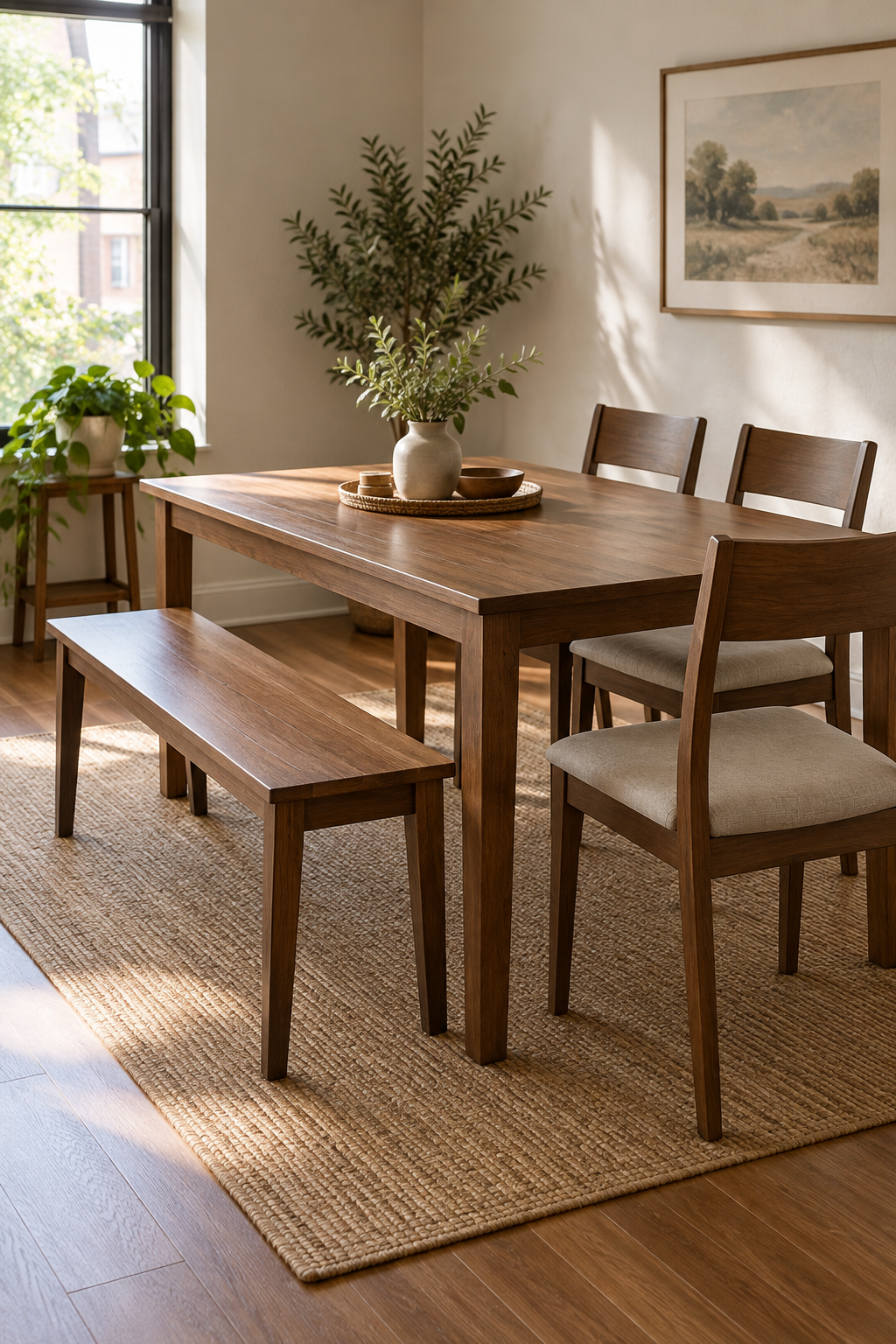
Judge a bench by entry and movement as well as its photograph. The original concepts show a plain bench beside a rectangular table and a shorter backed bench near a window. They illustrate different seating habits; they are not product recommendations or evidence that a particular bench will fit your room.
Decide who will use the bench most often
Start with the actual users. Someone who finds side-stepping difficult may prefer a separate chair. A person who regularly gets up during a meal needs an easy end position. Children may need appropriate individual seating rather than being lifted onto a broad bench with no foot support. A bench can serve some family members while others use conventional chairs.
Think about meal duration as well. A backless seat can be useful for a brief breakfast or flexible guest place, but may not suit a long seated activity. A cushion changes the effective seat height and firmness. Try the intended arrangement before treating a bench as a substitute for every chair. The bench's length does not tell you how comfortably its users can sit together.
Bench on the open side
Why this arrangement is useful
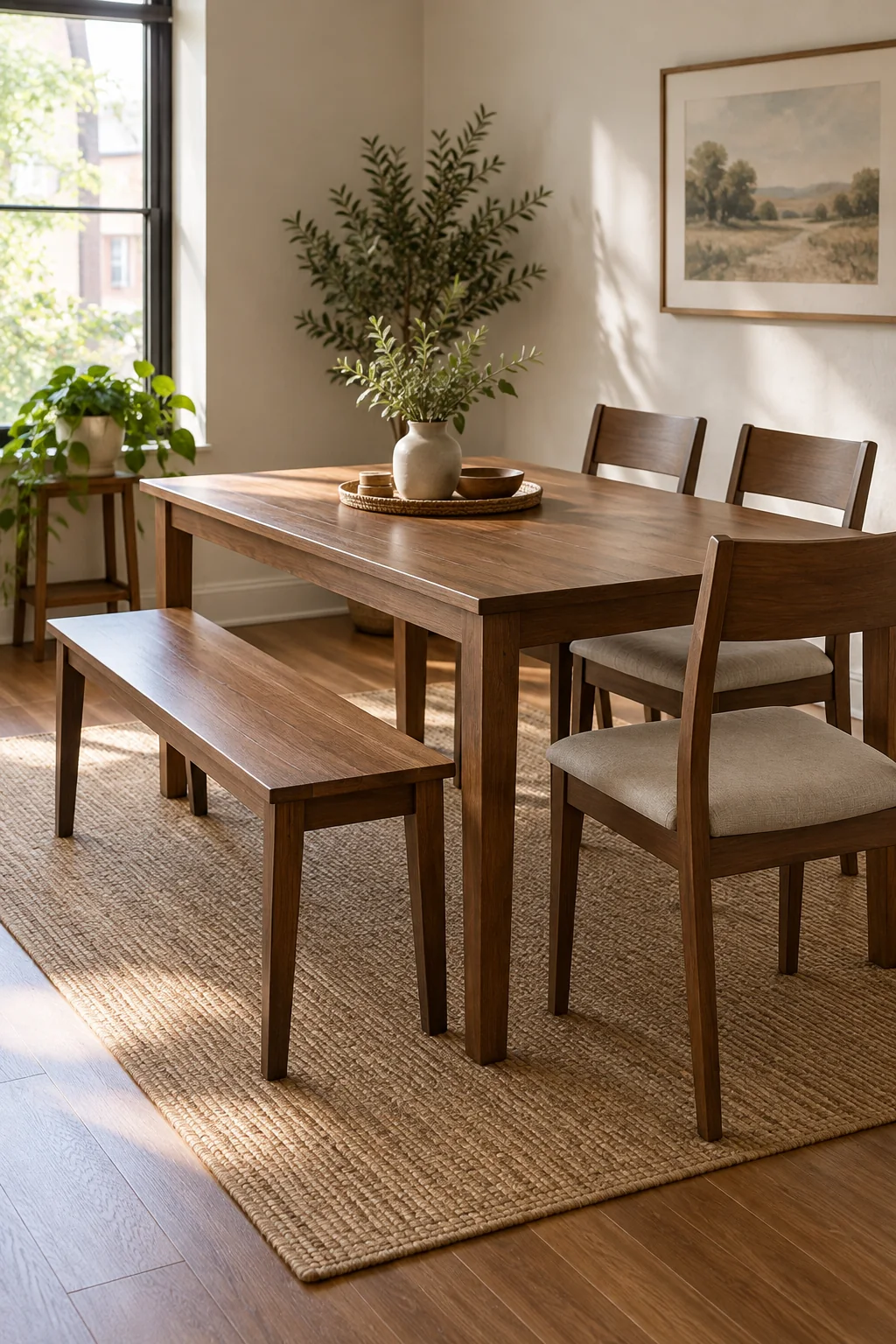
Users can approach the seat and the bench can move without being trapped at a wall.
Try the idea in your room
- Mark bench and table-support footprints.
- Try entry and exit with another diner seated.
- Choose a real parking and cleaning position.
Measure the space between table supports
Measure the clear gap under the table where the bench must slide, including legs, crossbars and apron. Compare it with the bench's widest frame dimension, not only its seat. Some seats overhang their legs; some benches have projecting supports. If the frame cannot pass between table legs, it will stay outside the top even when empty and consume more room than the photo suggests.
Measure floor-to-seat height and the underside of the tabletop or apron. Sit on the actual cushion if using one, because a thick soft pad changes thigh clearance. Avoid choosing a bench simply because its stated height resembles that of your chairs. Seat depth, back angle and position relative to the table affect how close a diner can sit.
Compare the everyday movement
| Bench type | Useful quality | Check carefully |
|---|---|---|
| Plain backless bench | Easy to approach from different sides | Comfort for the meal length and whether it tucks between legs |
| Short backed bench | A supported seat for a small household | Back projection, total depth and entry at both ends |
| Storage bench | Some storage close to dining | Seating suitability, lid movement, hinges and whether contents stay accessible |
| Long heavy bench | A continuous seat for a larger table | How many people are needed to move it and where it can park |
A hallway storage chest is not automatically dining furniture. Check the maker's intended use, load information and seat design. Do not place cushions on an ordinary low shelf and count it as a bench. If a product has a lifting lid, use its supplied instructions and keep fingers, children and table edges clear of the mechanism.
Arrangement: a plain bench on the open side
In the first concept, a solid backless bench sits on the open long side of a rectangular table, with separate chairs opposite. The open side gives users a route to the bench ends and lets the bench be moved without scraping a wall. This is useful when flexibility matters more than continuous back support. It also keeps a backed chair available for anyone who finds that more comfortable.
- Place the bench on the side with an actual movement zone, rather than trapping it between the table and wall.
- Leave the table supports visible during the mock-up and check that the bench can slide without collisions.
- Ask each intended user to sit, stand and move out while another person remains seated.
When the bench is not needed, do not assume it can tuck away completely. Measure the real tucked position and the route behind it. If moving it requires lifting, decide who can safely do so. Keep the floor clear before shifting the frame and protect the finish using pads compatible with the bench and floor, without making the seat unstable.
Arrangement: a shorter backed bench near a window
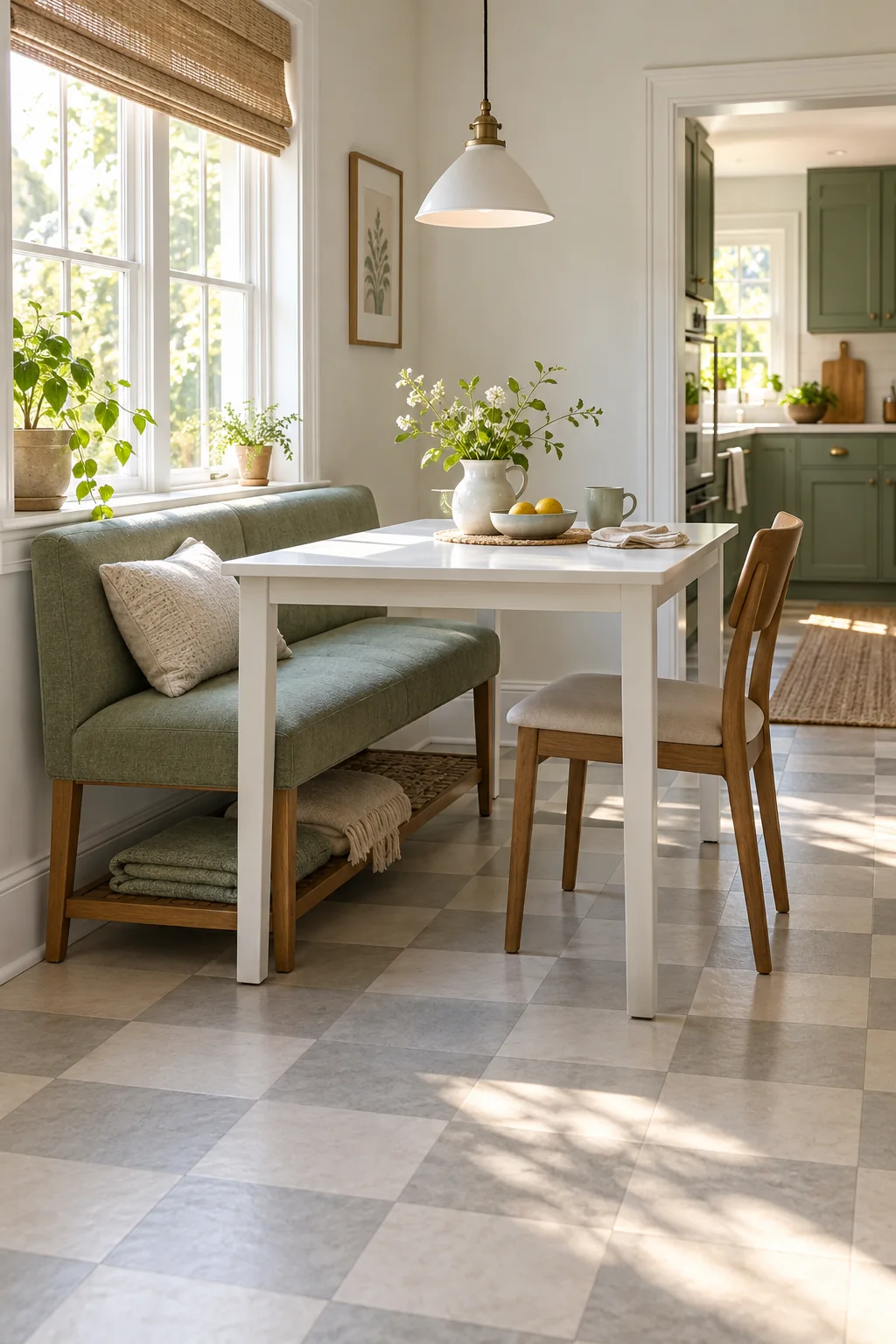
The second concept uses a short backed seat for a compact breakfast area. It occupies fewer daily places and gives each end a clear entry. The back adds depth, so the table is set forward enough for sitting rather than pressed against the seat. A lower shelf holds light textiles; it is not loaded with bulky objects that obstruct feet.
- Mark the full bench depth including the back, then place the table so diners can approach it comfortably.
- Keep at least one easy entry at the bench end for every regular user and check the other end is not blocked by a cabinet.
- Use the under-seat shelf only within its specified capacity and keep bags or loose straps out of the foot area.
This arrangement may feel settled like a banquette, but the bench remains independent furniture. Do not attach it to the window sill or use curtains as a back cushion. Keep radiator airflow and access to window controls appropriate for the actual installation. If the bench blocks a necessary control or ventilation opening, reposition it rather than treating the window wall as automatically available.
A worked fit test before buying
Suppose the clear gap between your table legs is110cm but the widest bench frame is118cm. The bench cannot pass between those legs even if the tabletop is140cm long. Those are hypothetical measurements, not this illustration's dimensions. A bench may still work outside the supports, but then its empty and occupied positions need separate floor space. Record the frame width, seat height, overall depth, table underside and end-entry routes on one sketch. Reject the arrangement if the only exit requires climbing over the seat.
Check real product instructions before purchase
As one specific example, IKEA's SKOGSTA bench, article 206.118.82, provides intended indoor use, measurements, assembly documentation and care instructions. Its guidance includes checking and retightening screws after assembly. Those details belong to that product; they are not a general load rating or maintenance schedule for every bench. Read the exact model's documentation before choosing a second-hand or new seat.
Inspect used furniture for loose joints, cracks, missing parts and prior repairs. Obtain the correct instructions and hardware where possible. A bench that wobbles during an empty test is not improved by adding diners. Avoid improvised repairs that change the frame or supports. Check recall information for an identifiable model if safety or condition is uncertain.
Plan movement and cleaning in a rental
A renter-friendly bench should be practical to transport, not simply unattached to the wall. Measure the doorway and stairs before delivery. Consider how it can be disassembled following the maker's process and whether its components will survive another move. Keep the assembly information and labelled hardware in a folder that moves with the furniture.
For everyday care, remove crumbs from seams and wipe surfaces as the maker directs. Fabric that cannot be cleaned easily may be a poor match for frequent food spills. A washable removable pad can be useful if it fits securely and does not hide damaged joints. Avoid pushing wet seating against a wall; allow cleaned surfaces to dry before replacing textiles.
Try the guest arrangement while the room is occupied
Guest capacity is not just the number of bodies that can fit along a seat. Place actual meal settings, occupy the adjacent chairs and check whether a person at the bench centre can leave. Reserve easy positions for people who need them. Do not promise extra seating by asking diners to perch on the ends beyond the supported seat.
The final test is a complete meal reset: pull the bench out, sit down, pass food, stand, clear dishes and move the bench for cleaning. If that routine is cumbersome, a pair of compact chairs may be the better rental choice. A bench earns its place when it simplifies the movements your household makes, rather than adding a daily furniture-shifting job.
Planning references reviewed on20 October2026
- IKEA: SKOGSTA bench, article 206.118.82: A specific manufacturer example of intended indoor bench use, measurements, care and assembly documentation; not a rating for other benches.
- IKEA: dining bench planning: Manufacturer guidance on bench dimensions, intended use and circulation; not a guarantee that every bench tucks under every table.
Continue with occupied dining-table footprint, the homework-to-meal reset or small-apartment dining corners.
Practical questions
Does a bench always save space compared with chairs?
No. A bench may tuck efficiently, but its full frame and the space needed to move or enter it can be substantial. Test it occupied and pulled back. A backed bench often has more total depth than its seat suggests.
Can I use any storage chest as a dining bench?
Only if the manufacturer designs and rates it for seating and the fit works at your table. A box or cabinet is not a safe seat merely because it has a flat top. Check the exact model, hinges, load instructions and condition.
Should a dining bench be fixed to the wall?
Follow the actual product and installation instructions. A purpose-built movable seat may be designed for independent use; a built-in or storage unit can have different requirements. Do not omit a required fixing to keep the arrangement renter-friendly.
Keep the useful part.
Keep one visual reminder of this guide. The illustration suggests a direction; the practical steps and fit checks above help you adapt it to your own room.