The gap behind a sofa looks like spare space, but it is not always usable storage. A console can add a lamp surface or a place for small daily items. A cabinet pushed against the sofa may add volume that nobody can reach. Decide whether the gap needs a surface, actual storage or simply access before buying furniture.
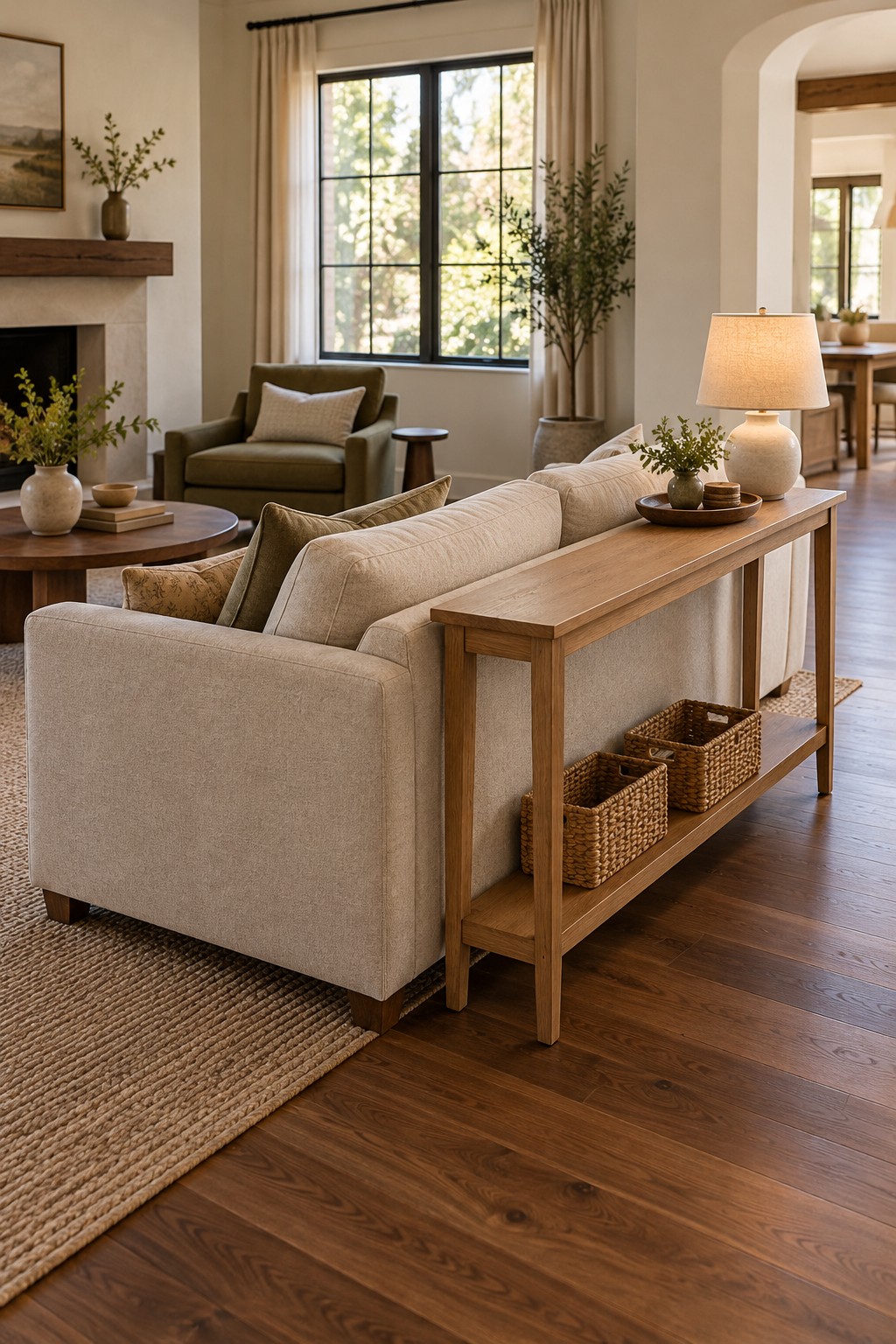
The two original concepts below separate the situations. One shows a floating sofa with a console reached from behind. The other shows a sofa near a wall with a shallow surface and separate accessible storage elsewhere. They solve different access problems rather than repeat the same piece in another colour.
Measure the sofa in its normal position
Measure the full sofa depth, back height, arm projections and how the cushions move in ordinary use. If it reclines or converts to a bed, include that operating footprint. Do not place storage where the furniture mechanism needs to move or where a cushion will press into a lamp.
Measure the actual gap from the sofa to the wall or route. Include skirting and the console's feet, not only its tabletop. A product described as slim can still be deeper than the gap once legs, trim and required wall clearance are counted.
Decide from which side the storage will be used. A lower shelf facing a rear route can hold small baskets that pull out toward the user. Cupboard doors facing the sofa back cannot become useful merely because the cabinet fits between them.
For an original width example, a 120 cm rear gap minus a 30 cm console depth leaves 90 cm before any other projections. That arithmetic can help compare a trial, but the remaining route must suit the actual users and the furniture's openings. The number is not an accessibility or building specification.
Use a console only where its storage can be reached
Why this arrangement is useful
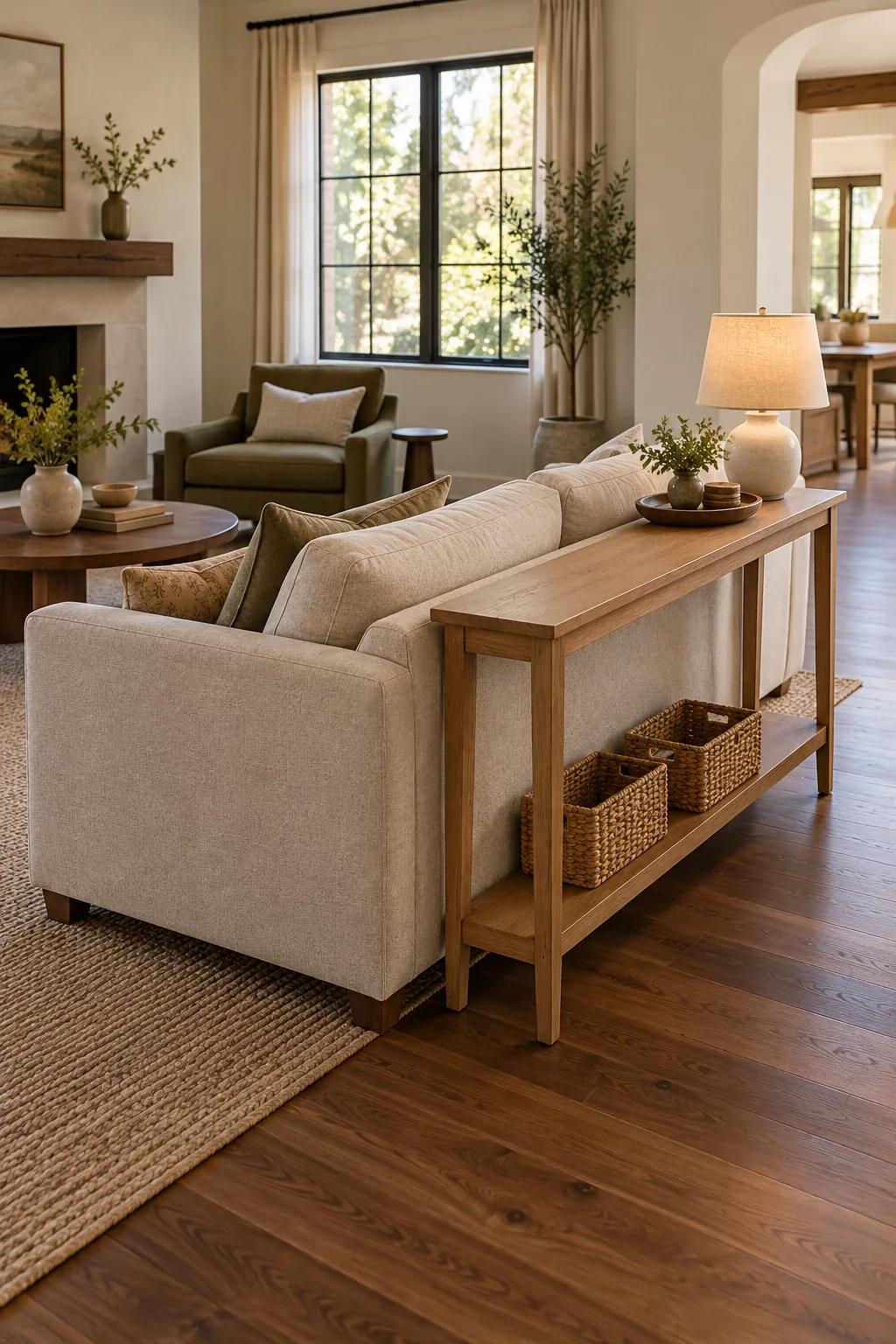
The lower shelf opens toward the rear route rather than becoming storage trapped against the sofa.
Try the idea in your room
- Measure the rear gap and tape the console's complete footprint.
- Test passing, basket removal and seated cushion movement before adding items.
- Use suitable furniture and arrange the lamp according to its electrical instructions.
Identify the job before choosing the furniture
A lamp and a tray need a stable surface. Games or small blankets need accessible capacity. Large objects and deep folded textiles may not belong in a shallow piece at all. Write a short list of what you plan to keep there and measure those items before choosing shelf depth.
Check how objects will be returned. A basket behind the sofa is useful only if the regular user can reach it without climbing across upholstery or shifting a heavy seat. A storage position that requires dismantling the room will probably become either unused or permanently messy.
Where the sofa is close to a wall, the most useful role may be a modest surface with actual storage elsewhere. That can hold a lamp or a small tray without claiming to replace a cupboard. Keep the arrangement honest about what it can contain.
Compare the options
| Space behind the sofa | Useful option to trial | Reason to stop |
|---|---|---|
| Rear walking route with room for furniture | Slim console with accessible shelf or drawer | The piece or its opening makes the route unusable |
| Small gap against a solid wall | Appropriate shallow surface only | Its support, cleaning access or sofa movement is compromised |
| Reclining or converting sofa | Keep the operating zone clear first | Any part of the storage interferes with the mechanism |
| Heater, vent or service access in the gap | Follow the fixed feature's requirements | Furniture blocks required airflow, clearance or access |
Arrangement one: a floating sofa with a rear-access console
The first concept places a narrow console behind a floating sofa. The lower shelf and its small baskets face the rear route, so they can be used without touching the seating. The lamp and tray occupy only part of the top; the furniture is a useful boundary, not a long display shelf filled with objects.
Recreate it by measuring the rear route before choosing the console. Set the sofa in its normal position, tape the console footprint and walk past carrying an ordinary household object. Then test pulling a basket or opening a drawer while standing there.
Choose a piece intended for its load and follow its assembly and fixing instructions. Check the top against the sofa back while someone sits down and the cushions compress. A table that looks level with an empty sofa may become an awkward hard edge behind the occupied seat.
The tradeoff is depth. A useful shelf or drawer needs more room than a thin surface. If it narrows a daily route, reduce the stored volume or move it elsewhere rather than expecting people to squeeze past.
Arrangement two: a shallow surface near the wall
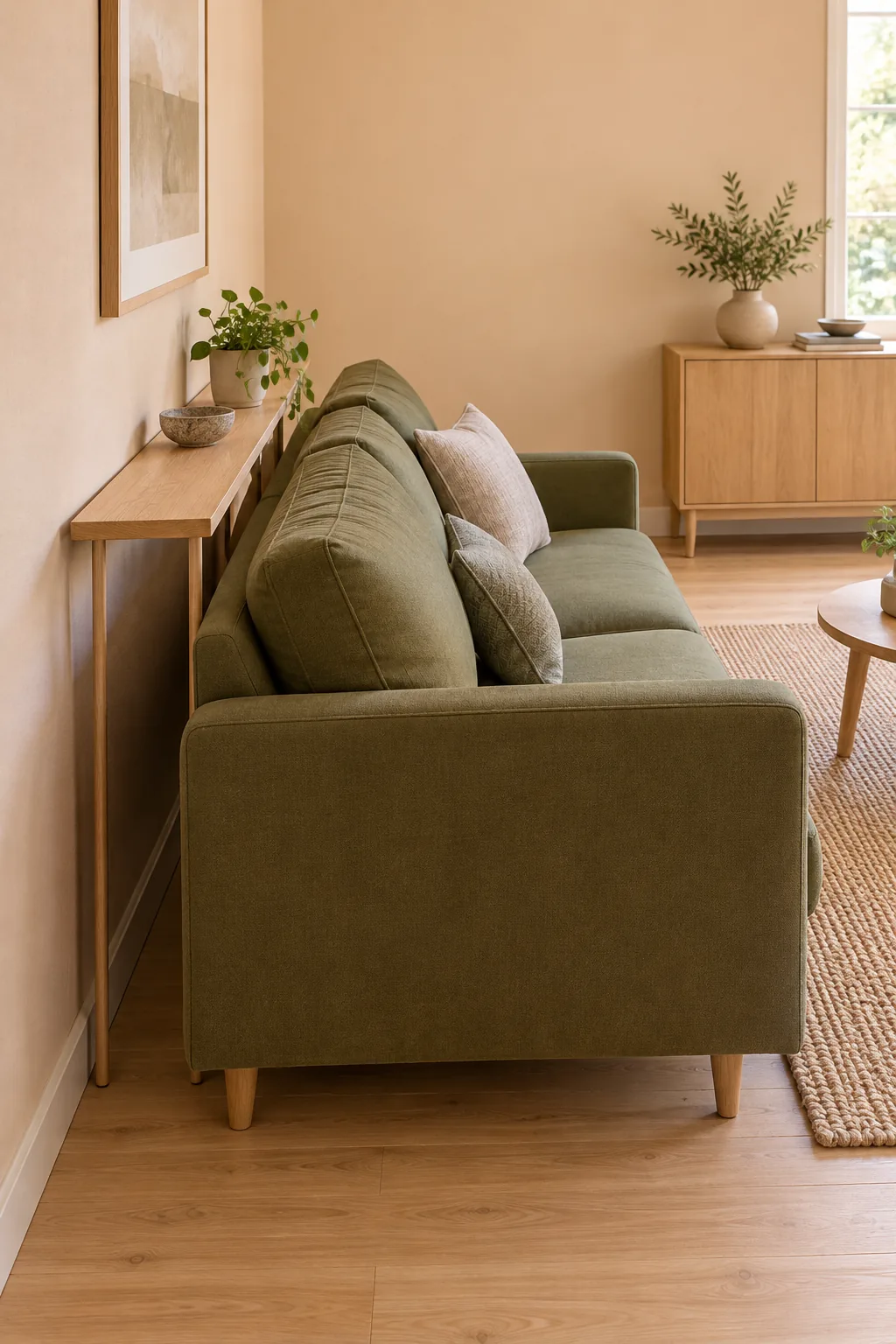
The second concept shows a very shallow freestanding surface behind a sofa close to a wall, while closed storage remains at the side where it can open. There is no claim that the narrow gap contains a full cupboard. The surface supports a small number of objects and leaves the main route in front and alongside the sofa.
Try this only with a suitable stable piece that fits the actual gap and the sofa's movement. Do not improvise a long unsupported plank or balance a surface on unrelated furniture. A slim table may require particular bracing or fixing; follow its construction instructions rather than copying the apparent supports in an image.
Keep objects low and limited so they do not press into cushions or become difficult to retrieve. If something falls behind the sofa, it should be possible to recover it without a risky reach. Choose a different surface location if routine use depends on leaning heavily across the sofa back.
Make openings and reach part of the storage calculation
Measure a drawer fully extended and add the user's standing position. A 25 cm deep piece can still have an opening that takes much more space. For shelves, measure the basket's removal path rather than only the shelf interior.
Keep frequently used items in the most comfortable reach. Occasional items can go elsewhere instead of taking over a difficult lower shelf. A shallow console is particularly useful for small everyday objects that are easy to return, not as a replacement for all the room's storage.
Do not trap a cabinet's doors against the sofa or the wall. In an open room, the cabinet may need to face the rear route. Check the appearance of its back as well as its function; some furniture backs are not intended to be exposed or to carry extra fixtures.
Plan lights and charging without a cable tangle
A lamp can work well on a console when the base fits securely and the switch is reachable. Position the lead so it does not run through the cushions, around a moving sofa mechanism or across the route. Follow the lamp and furniture instructions for support and cable arrangement.
Use adapters and charging equipment according to their instructions, with suitable ventilation and access. Do not conceal them in a tight gap. A new socket needs a qualified professional.
Keep drinks where they can be set down without reaching over electrical equipment or stretching across the sofa. If the main purpose is a drinks surface for someone seated, a side table may be easier. The two-doorway living-room guide helps compare these surfaces against the room's main route.
Cleaning, wall access and fixed features
Keep a way to inspect and clean behind the sofa. A new surface should not turn an accessible gap into a permanent hidden strip. Where the wall has dampness or recurring condensation, investigate the cause instead of covering it with furniture; EPA moisture guidance is a primary reference for that problem.
Check for heaters, vents and access panels before treating the rear gap as available. Follow their actual requirements. A shelf or console should not be placed above or in front of a heater merely because it fits the width of the sofa.
Preserve the access needed to clean, inspect the wall and reach service points without dismantling major furniture.
Budget and renter-friendly implementation
Start by testing whether the sofa needs rear storage at all. An existing stable side table may solve the lamp or drink problem without adding a long piece. If small objects have no home, clear a drawer in accessible existing furniture before assuming the rear gap must provide new capacity.
A freestanding console is easier to revise than fitted shelving. Read its full dimensions and instructions. IKEA's LISTERBY console page is a primary example of a table with a lower shelf; the product category alone does not establish suitable depth, load or fixing for your gap. Its listed 15-inch overall width is about 38 cm, so it would leave about 82 cm in the illustrative 120 cm rear gap, not the 90 cm left by a hypothetical 30 cm piece. That comparison is a reason to check the actual product footprint rather than assume a table called a console is shallow enough.
Renters should discuss required fixing where necessary. Follow anti-tip instructions for any associated cabinet, and do not substitute adhesive fittings for specified support. Keep decorative changes reversible while using each furniture piece as designed.
A quick sofa-back reset
- Return only the intended small items to the tray or accessible shelf.
- Check baskets and furniture feet do not project into the route.
- Check the lamp lead and the sofa's movement.
- Remove objects that cannot be retrieved comfortably.
- Inspect the gap and preserve the planned cleaning access.
If the console fills with unrelated belongings, review its job. Keep its function small enough to preserve the route.
Common mistakes and planning references
Avoid buying by the word slim, counting blocked cupboard volume as storage and placing a hard surface where cushions or a mechanism need to move. Do not improvise structural support from the image. Primary references reviewed on 18 October 2026: IKEA LISTERBY console documentation and EPA moisture guidance. The two arrangements and width calculation are original editorial examples.
Practical questions
Can I put a storage cabinet directly behind a sofa?
Yes, only when its doors or drawers and the user's standing position remain accessible. A cabinet pressed against the sofa can add inaccessible volume. Measure the working opening and preserve the main route before choosing it.
Should the console be the same height as the sofa back?
Compare the actual table height with the occupied sofa and its moving cushions, not a visual rule alone. Avoid a hard edge that interferes with seating or a lamp position that is difficult to reach. The chosen furniture's instructions and stable use matter more than matching heights exactly.
Is a very narrow gap enough for a useful shelf?
It may support a suitable shallow surface, but check construction, sofa movement, retrieval, cleaning and any fixed features. It does not automatically support a cupboard or a homemade unsupported plank. A side table may be the more practical solution.
Keep the useful part.
Keep one visual reminder of this guide. The illustration suggests a direction; the practical steps and fit checks above help you adapt it to your own room.