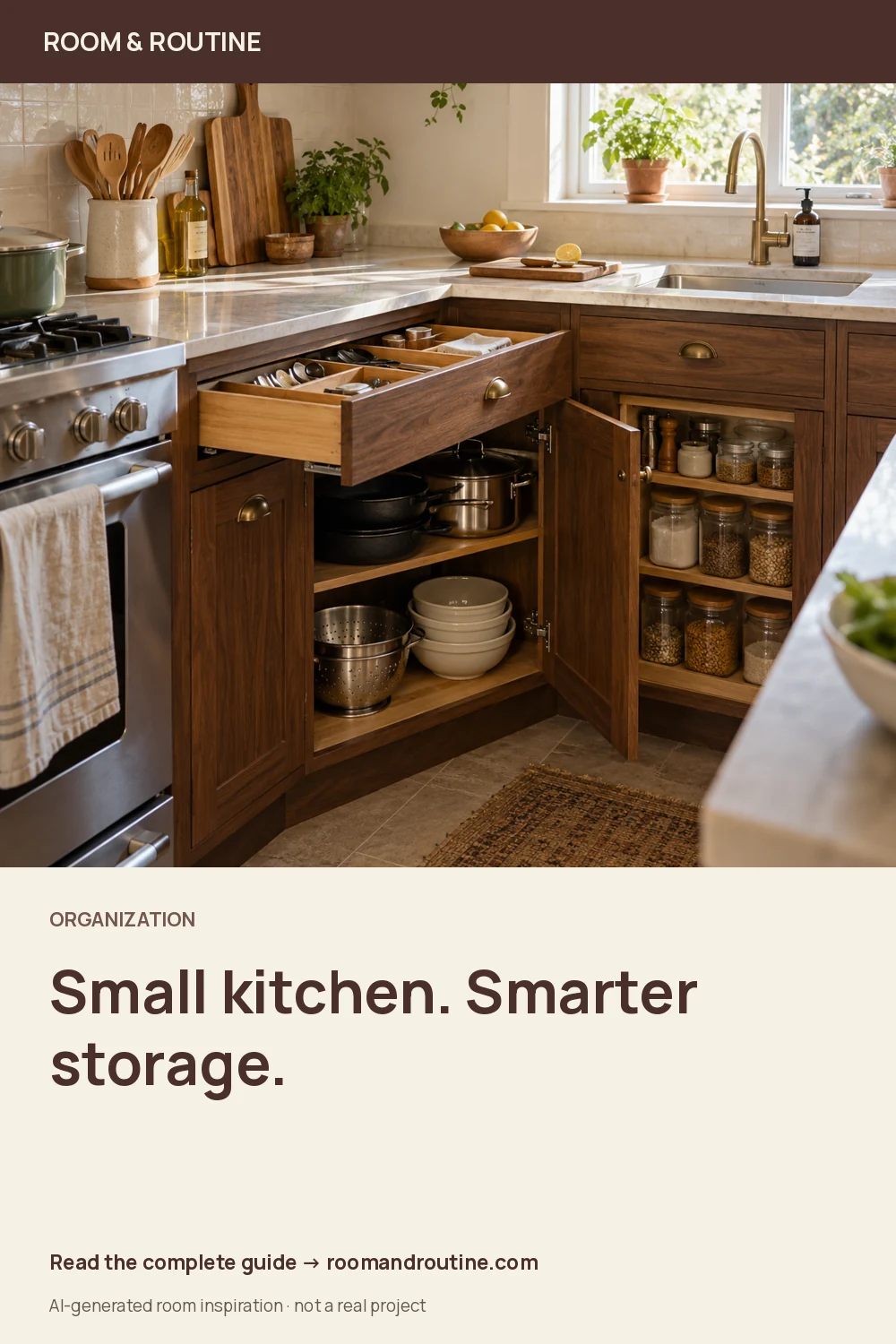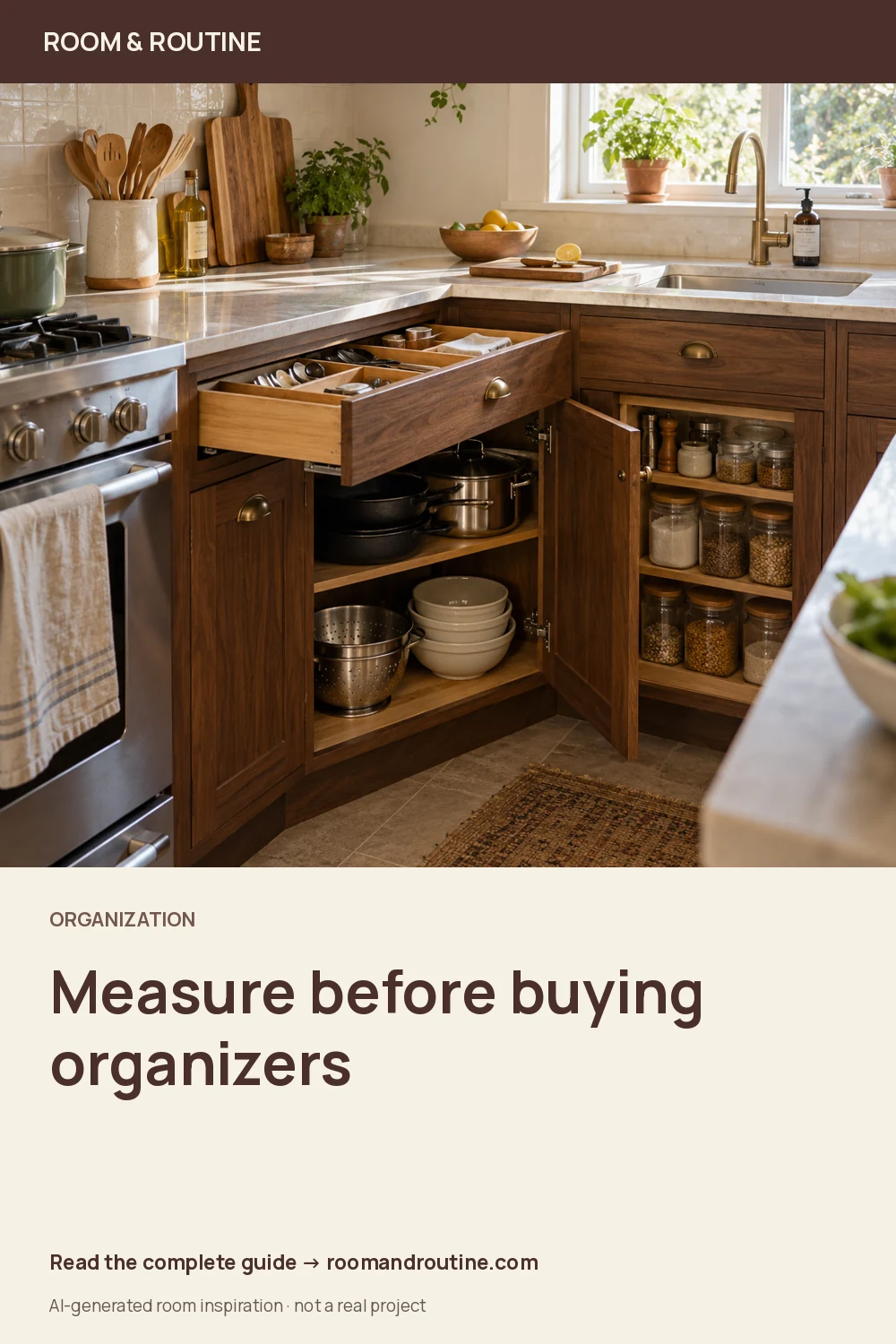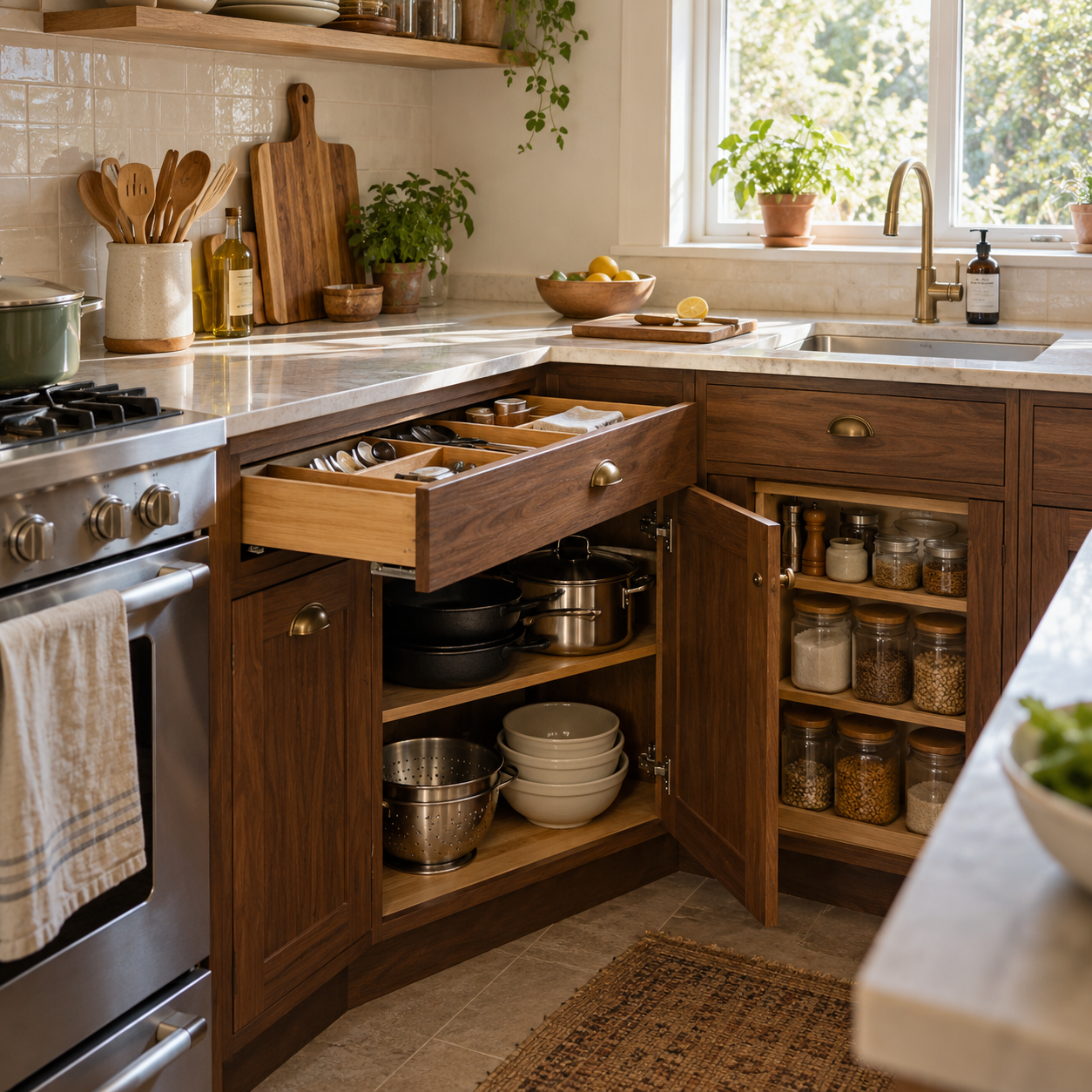
Start with one frustrating kitchen task
Choose the moment that regularly slows you down: making breakfast, putting clean dishes away or finding a pan lid. Watch that task from start to finish. Which cupboard do you open, what must you lift out, and where does the packaging end up? A kitchen can look tidy and still be inconvenient if everything needed for a single activity is stored far apart. Work on that activity first instead of emptying every cabinet at once.
Clear just its shelf or drawer and group the contents. Put frequently used items together, set aside things that belong elsewhere and check dates and product labels where relevant. Keep the food safety and care instructions for the actual products you use. This guide is a storage workflow, not advice to change how a food or household chemical should be stored.
Measure the usable interior, not the door
Record the cabinet's clear width, depth and height at the position where an organizer would sit. Hinges, shelf supports, pipes and the lip of a drawer can reduce that space. Check whether the door can close with an object near the front. A box matching the external cupboard width may not fit through its opening or may prevent another part from moving.
For a pull-out accessory, include the fully extended position and any installation clearances specified by its manufacturer. For a shelf riser, measure the items below and above it rather than choosing its height from a picture. Write these dimensions next to the group of contents. If you cannot confirm fit, use an existing container for the trial instead of ordering several matching organizers.
Build a few useful zones
Put the items for everyday preparation near the surface where you prepare food, where their storage instructions permit. Group washing items around their appropriate storage location, and give clean plates and cups a place that is convenient to put away. These are starting points, not rigid rules: the actual plumbing, household members and usable cupboards determine what works.
Keep hazardous products in suitable storage, follow their labels and consider children, pets and other household needs. Do not transfer products into look-alike food containers just to create a uniform shelf. A attractive organization system must still make it easy to identify what each item is and use it correctly. Retain labels and important dates when changing storage.
Use height where the contents justify it
A tall gap above short mugs may be useful for a suitable freestanding shelf insert. Stacking can also work for items designed to stack. Test whether you can remove the one you need without destabilising the rest. Adding another level is less useful if it makes everyday contents difficult to reach or requires unloading half the cupboard.
Measure weight as well as space where the storage product specifies a load limit. Use shelf and cabinet fittings according to their instructions. Tall or installed storage may need proper fixing; do not treat a hook or tension fitting as a universal solution. Choose the simplest arrangement that holds the actual contents and leaves each regular item accessible.
Protect a working surface
Choose the part of the worktop where you do most preparation. Look at the appliances and jars stored there and separate daily essentials from occasional tools. A frequently used appliance can deserve its space. Something used monthly might have a suitable cabinet home. The decision is about the household's routine, not an ideal image of an empty countertop.
Keep an area usable without moving several things before every task. Do not relocate appliances where ventilation, electrical instructions or distance from water would become unsuitable. If a useful object has no safe, accessible alternative position, it may be better to keep it out and change the surrounding storage instead. Follow each appliance's instructions over a styling suggestion.
Review what happens after a week
Take a simple record of the arrangement, then use it normally. Notice whether clean dishes return easily, labels remain readable and empty packaging has somewhere to go. If items gather beside their intended cupboard, the assigned location may be inconvenient. Change that one location before buying another container. An organizer cannot make a poorly placed category feel natural.
Keep a short cabinet inventory with clear measurements and the item groups that fit. This prevents repeat purchases of containers that solve the same problem badly. If you want a colour direction for visible shelves, Palette Lab can help you keep it restrained, but the storage should work without a colour scheme. Start with one successful cabinet and extend the method only when it has proved useful.
Try a measured furniture arrangement in the 3D Room atelier ↗
Keep the useful part.
Save the full guide to Pinterest or download a vertical graphic. Room imagery is illustrative and AI-generated, not a photographed result.