Direct answer: Measure the drawer's usable internal height, width and depth, including any pipe cut-outs, before selecting organisers. Keep a shallow daily group at the front and only suitable dry spares behind it; test complete drawer closure with the actual contents before adding more compartments.
The advice starts with the existing room, product instructions and a practical household routine. The images are original AI-assisted concepts for planning, not photographs of completed projects or technical installation drawings.
Organise the moving drawer, not the countertop above it
A small vanity drawer often looks larger from above than it behaves in use. A tall jar fits inside the open box, then catches underneath the counter when the drawer closes. A divider fits the advertised cabinet width, then meets the runner or pipe recess. Start with the moving drawer itself. Remove ordinary contents, inspect the construction without dismantling unfamiliar mechanisms and note what can be reached when the drawer is normally open. Choose organising accessories from those usable dimensions.
Watch one ordinary grooming task. Which items come out first, which remain unused and what tends to fall into the back? The best drawer plan reduces that searching. It does not need to display everything owned or provide a compartment for every possible product. Identify the daily group, occasional grooming tools and suitable unopened spares. Items with storage instructions unsuited to the bathroom should go to an appropriate location. This guide is not advice to move medicines into a vanity or transfer products from their original containers.
Match the compartments to the tools
Why this arrangement is useful
Long grooming items have a clear strip rather than sitting across smaller sections.
Try the idea in your room
- Measure internal dimensions and clear closing height.
- Choose compatible shallow dividers around the actual grooming items.
- Fill only daily groups and test normal opening and closure.
Take useful internal measurements
Measure inside width and depth at the narrowest usable points, then check the clear height beneath the cabinet structure as the drawer closes. Include dividers, a liner if permitted, bottle caps and tray handles in that height. Record pipe cut-outs, supports and any inset drawer back. Leave these intact and preserve access to plumbing. An organiser that bridges a recess may become unstable or make a leak harder to notice. Do not cut the drawer or change plumbing to make a store-bought tray fit.
Test the closing movement gently with the empty proposed organisers first. A tray can fit the base but protrude into a drawer-front lip or rear support when moved. Then add the actual objects and test again, without forcing the drawer. Observe whether bottles roll, a comb catches or loose packaging rises above the edge. The drawer should work normally without one special rearrangement each time it closes. If it does not, reduce organiser height, simplify the contents or choose a different layout.
| Drawer condition | Useful starting layout | Check before buying |
|---|---|---|
| Wide but shallow drawer | Low adjustable divisions and flat daily items | Comb and cap heights during closure |
| Narrow drawer | One or two small removable trays | Tray lifts out without catching the sides |
| Pipe recess or interrupted floor | Separate suitable trays within clear areas | No bridging, blocked access or altered plumbing |
| Frequently damp contents | Review drying and storage location first | An enclosed drawer must not hide a moisture problem |
Arrangement A: shallow divisions with a visible daily group
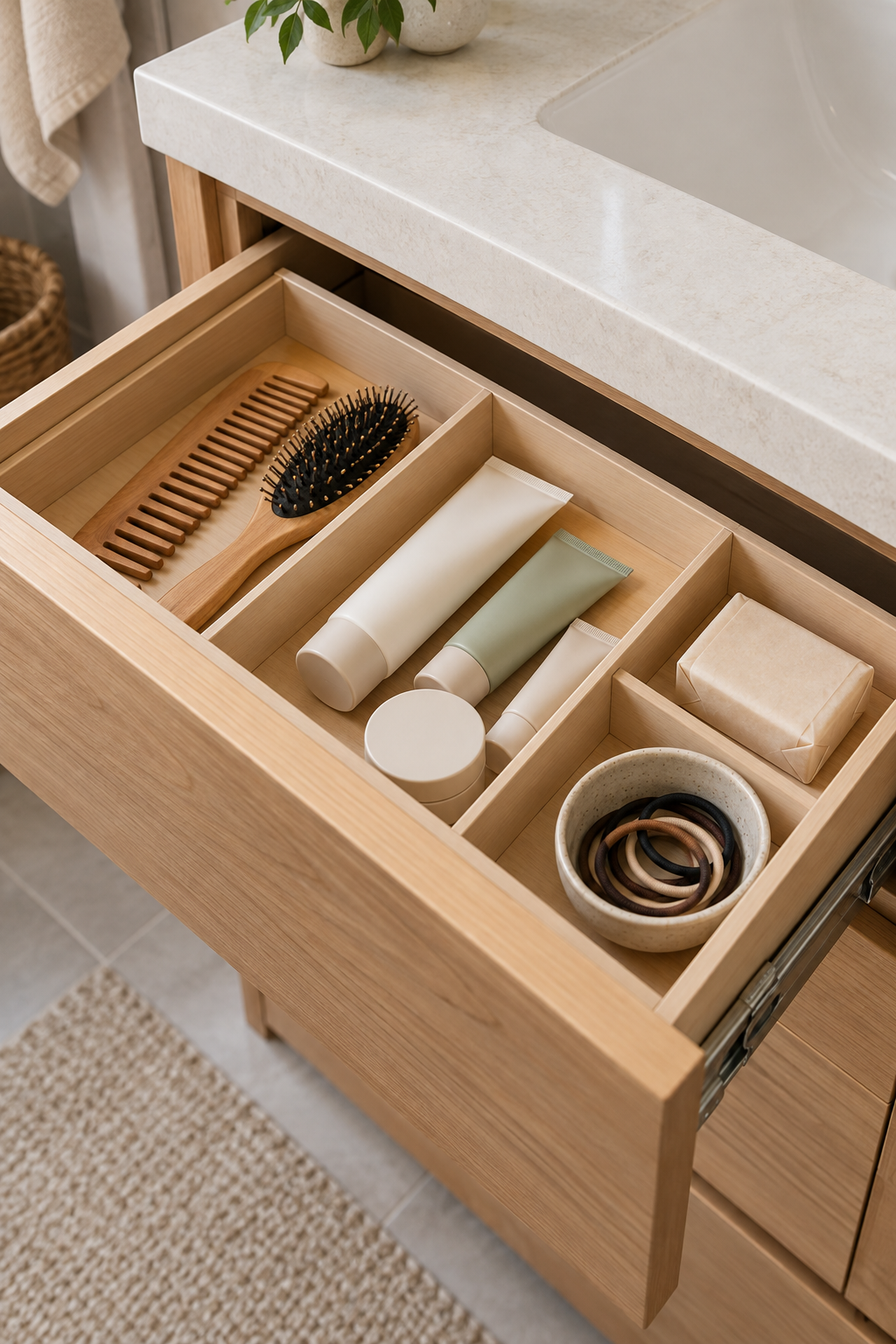
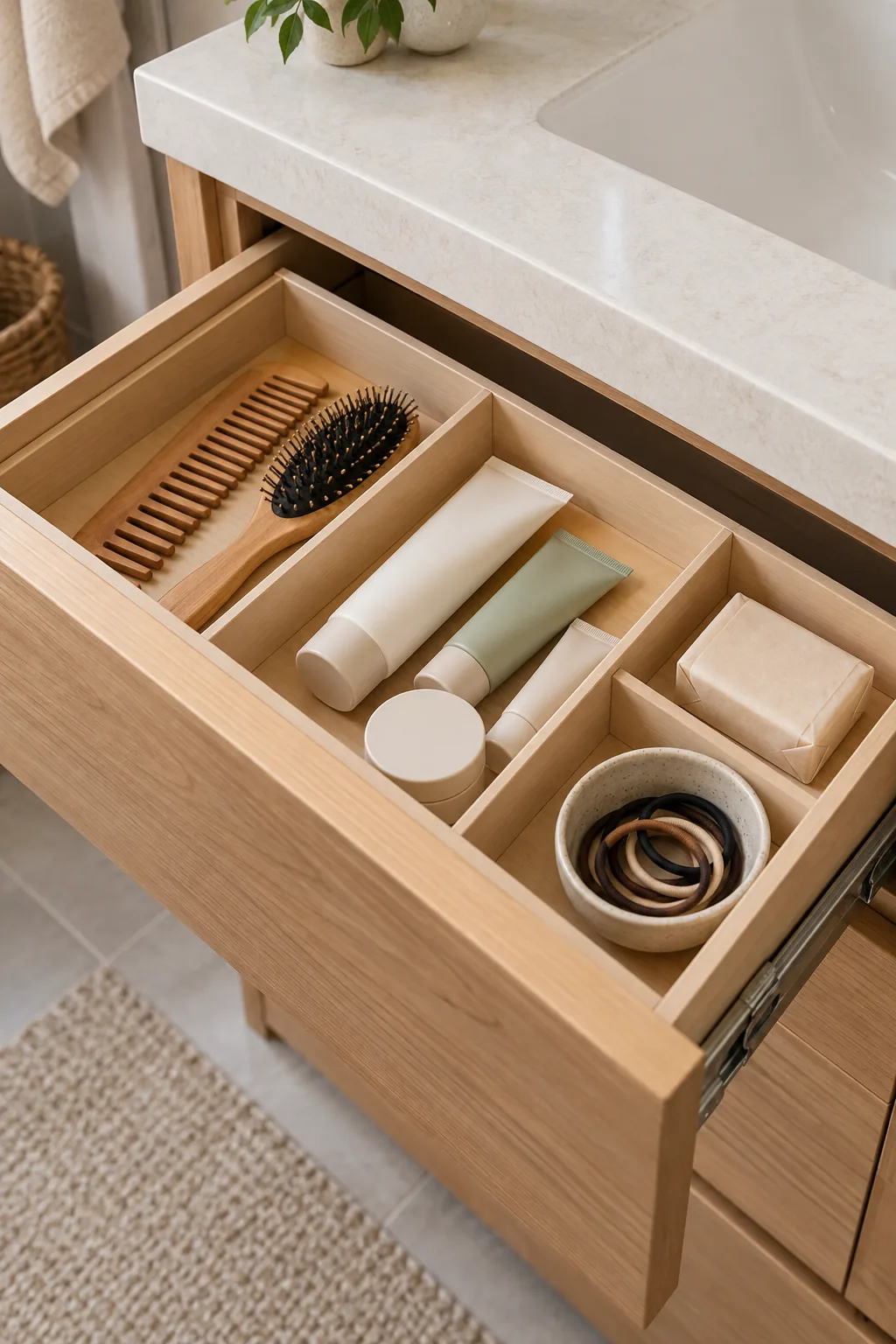
The first concept gives a comb and brush a long compartment, closed everyday tubes a central group and small accessories their own modest area. These groups correspond to how they are retrieved. A large brush does not belong diagonally across several compartments simply to make the organiser appear full. Choose dividers that can be adjusted around the real items and are compatible with the drawer. A fitted-looking arrangement should still leave the objects easy to lift and the drawer easy to close.
Place the most frequently used group at the reachable front or side that suits the drawer's opening. Keep the total contents low enough that the top of each compartment remains visible. If a capped tube changes height as it is used or replaced, allow for the full original package rather than just the current nearly empty one. Small loose items can sit in a suitable shallow container so they do not migrate beneath the divider. Avoid open sharp tools in an everyday catch-all compartment; use appropriate protective storage for the actual item and household.
Arrangement B: removable trays in a narrower drawer
The second concept uses two modest washable trays, with one shown removed onto a dry surface for cleaning. This is useful when a narrow drawer cannot support a broad full-width organiser. A tray can also hold a complete grooming task that is carried to another room. Its shape should fit the drawer without needing to wedge into the sides. Leave enough hand space to lift it, and test the weight of its actual contents before deciding the removable method is convenient.
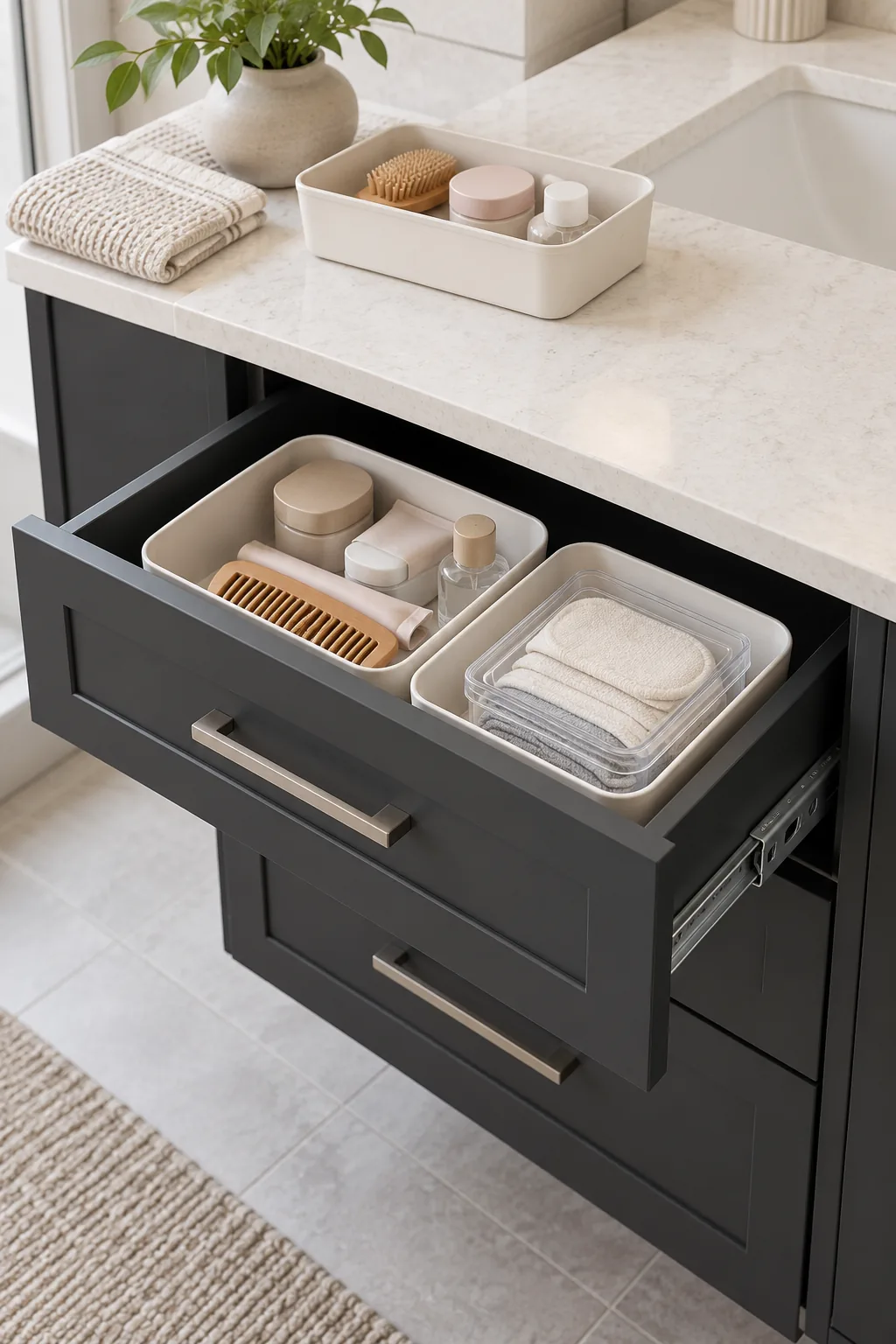
A closed container for suitable dry cloth pads or small accessories can keep a category together, but it needs to be appropriate for those contents and storage conditions. Put only dry clean items into it. The concept does not recommend sealing damp textiles or swapping products into unlabelled jars. Keep instructions and identifying packaging where necessary. A removable tray is an organising tool, not a guarantee that everything inside it can be safely stored in a bathroom.
Choose the smallest useful categories
Group by next action: hair grooming, daily face-care products, small accessories or a limited suitable spare supply. Combining unrelated items into one category called miscellaneous usually makes the drawer harder to review. At the same time, avoid an excessive number of tiny compartments. If you must remember a special place for every hair tie, the arrangement may be more complicated than the task. A small shallow accessory dish can work better than an elaborate grid when the objects are repeatedly added and removed.
Daily and reserve supplies need different access. Put the current product where it is easy to pick up, and keep a suitable spare behind or in another appropriate storage location. Check before buying a replacement so unopened duplicates do not displace everyday tools. If several people share the drawer, choose a modest removable group for each or agree which supplies are shared. Personal tools should stay recognisable. Symmetry is optional; using equal-sized trays for people with very different daily needs can create unnecessary wasted space and overflow.
Reset the drawer in a useful order
- Remove ordinary contents and identify unsuitable, unused or duplicated items without altering cabinet mechanisms.
- Measure the actual internal box and clear closing height, including recesses and hardware.
- Test low organisers empty, then fill them with only the daily groups.
- Close and open gently, checking that nothing catches, rolls or prevents normal movement.
- Add a small suitable reserve group only after the daily arrangement works.
Clean the empty drawer and organisers using methods appropriate to their materials, then allow them to dry before replacing items. Read the cabinet instructions before using liners or moisture-trapping mats. A drawer that smells damp or has a recurring stain needs the cause investigated. EPA's moisture guidance advises fixing water problems and drying affected areas. Report rental leaks to the responsible party rather than disguising them underneath a new divider.
Make returning an item as easy as finding it
The front of an organiser often stays tidy while the back becomes a overflow zone. Give each daily group a defined capacity and leave a small clear space for normal changes. If a new item enters, decide which category it belongs to before dropping it behind a tray. If no sensible category exists, it may not belong in this drawer. The spare space is useful for adjusting the system and seeing the base, not an invitation to add every promotional sample to the bathroom.
Put used grooming tools back only in a condition suitable for their storage instructions and hygiene needs. Give damp textiles and used cloths their separate drying or laundry routine. Keep cleaning chemicals in appropriate original labelled storage, outside this grooming arrangement. EPA's household-product guidance emphasises following labels and not transferring hazardous products into food containers. Do not turn the drawer reset into decorative decanting, especially where similar containers could make personal-care and cleaning products hard to distinguish.
Use a week's behaviour to refine the fit
After several ordinary mornings, notice which object is always lying across a divider or which tray is never removed because it is awkward. Adjust that one point. A long comb might need an undivided strip instead of a small square. A cap may require the tube to lie flat. A frequently used item may need to move forward. These small changes are easier and cheaper than replacing the whole organiser whenever the grooming collection changes.
If the drawer becomes a place to store powered tools, stop and check their instructions, cooling and appropriate storage conditions. This article's designs deliberately contain no powered equipment. Do not coil a still-hot tool into a small compartment or assume an organiser determines a safe bathroom electrical arrangement. Keep loose sharps and hazardous items in appropriate protective storage. The goal is an understandable everyday grooming drawer, not a home for everything that can physically fit beneath the sink.
Budget priorities and avoidable mistakes
Start with sound existing small containers and test their fit before shopping. Buy one low removable tray or compatible divider to solve the most persistent searching problem. A full custom insert is useful only after the dimensions and categories are settled. Do not choose a product based on the outer cabinet width or a photograph of another drawer. Spend on the usable internal fit, washable material where appropriate and easy removal rather than an expensive material that cannot handle the room's conditions.
Avoid overfilling, forced closure, stacking daily products in hidden layers and bridging pipe cut-outs. Other common errors include holding onto every sample, mixing reserve products with active ones and using a liner to hide damp marks. Review the drawer when a daily product is replaced: remove obsolete packaging, confirm the contents remain dry and check normal movement. A successful vanity drawer has enough organisation to guide the next action and enough open space to remain usable as everyday items change.
Planning references reviewed on 28 October 2026
- EPA: A Brief Guide to Mold, Moisture and Your Home: Moisture prevention and reporting leaks; storage furniture cannot repair damp conditions.
- EPA: Household Hazardous Waste: Original labelled chemical containers, label instructions, incompatible leftovers and local disposal.
- FDA: Shelf Life and Expiration Dating of Cosmetics: Bathroom moisture can affect cosmetic storage; follow product storage and disposal directions.
Practical questions
Should I buy an organiser matching the vanity's outer width?
Measure the drawer's actual internal box and clear closing height instead. Cabinet sides, runners, pipe recesses and hardware can reduce the usable space. Test the complete organiser and contents before closing normally.
Can I cut a divider or drawer around the sink pipe?
Choose suitable organisers that fit the existing clear areas. Do not alter unfamiliar drawer mechanisms or plumbing to make a tray fit. Preserve access and obtain appropriate advice if the cabinet needs modification.
What should I do if the drawer keeps getting damp?
Find the cause rather than covering it with a liner. Dry suitable items before storage, investigate leaks or repeated moisture and report rental problems to the responsible building party. Move unsuitable contents elsewhere.
Keep the useful part.
Keep one visual reminder of this guide. The illustration suggests a direction; the practical steps and fit checks above help you adapt it to your own room.